Showing posts with label stability. Show all posts

Saturday, March 01, 2014

Do you remember...?

Do you remember about how the START Treaty was going to make the world a safer and more stable place? I do.

Do you remember a time when Nations would actually declare their intentions and declare war before invading another country so that civilized norms between Nations are affirmed? I do.

Do you remember when the Left wanted the world to hold to standards of International Law? I do.

Do you remember when the Left criticized drawing lines and making threats as a serious destabilizing element of foreign policy? I do.

Do you remember a time when a President of the US would decry an act against International Law and the Laws of War as such? I do.

Do you remember a time when a President would have just said the plain things about International Law, the Laws of War and that the US decries barbaric invasions of an undeclared nature as making a Nation into a rogue as such activities were destabilizing to all Nations? I do.

Do you remember a time when a President, seeing foreign aggression would speak openly about working with our allies so as to formulate a response against rogue regimes? I do.

Do you remember a time when the Left decried activities of the US in the past when each and every particular of International Law was seen as unjust and that made the US a barbaric place? I do.

Do you see the way the Left reacts to this and how it now, when push comes to shove against a barbaric actor who does things against all standards of International Law, are making excuses for him? I do.

Yes I do remember these things and see the response of the oh-so righteous Left when a tyrant decides to just step into a place on his own without declaring war.

I remember that with Austria by reading history.

I remember that with Saddam Hussein and Kuwait by seeing it unfold.

I remember that by seeing Congress draft modern day uses of force, which are declarations of war, and having the Left decry the civilized manner of work between Nations as ‘illegal’ and ‘uncivilized’.

And now I see it again with Putin and Russia.

And I also see the inability to address civilized standards of diplomacy, the normality of relationships between Nations and the laws of war as part of the way civilized Nations act as not being upheld by the Left today.

Yes I see all of that and understand who the enemy is.

They are clear by their actions and inactions, both.

Thursday, June 28, 2012

First thoughts

On the SCOTUS decision today I only have a few thoughts.   The decision is here, and I did a quick scan of it to see what the actual decision was... again this was a comment at Hot Air and for now that is it.  I'm seeing what others have to say, of course, and take my own council not that of fear.

With no other fanfare -

= = =

From p.32 of the decision:

Under the mandate, if an individual does not maintain health insurance, the only consequence is that he must make an additional payment to the IRS when he pays his taxes. See §5000A(b). That, according to the Government,means the mandate can be regarded as establishing a condition—not owning health insurance—that triggers a tax—the required payment to the IRS. Under that theory, the mandate is not a legal command to buy insurance.Rather, it makes going without insurance just another thing the Government taxes, like buying gasoline or earning income. And if the mandate is in effect just a tax hike on certain taxpayers who do not have health insurance, it may be within Congress’s constitutional power to tax.

It MAY be within Congress’s power. MAY?

Oh, and you must take a positive action to purchase said goods he uses as examples. You do not pay a penalty for not purchasing gasoline, or for earning no income. Although if he is making THAT connection then welcome to the mandated penalty for gasoline purchase and to the penalty for not earning income. Won’t those be swell brand, spanking new taxes in the future?

And then this following:

The question is not whether that is the most natural interpretation of the mandate, but only whether it is a “fairly possible” one. Crowell v. Benson, 285 U. S. 22, 62 (1932). As we have explained, “every reasonable construction must be resorted to, in order to save a statute from unconstitutionality.” Hooper v. California, 155 U. S. 648, 657 (1895). The Government asks us to interpret the mandate as imposing a tax, if it would otherwise violate the Constitution. Granting the Act the full measure of deference owed to federal statutes, it can be so read, for the reasons set forth below.

Roberts then repeats this pattern at each instance showing that there is a similarity between a power to tax purchases and the power to tax inactivity.

He looks at the Child Labor Collection Tax which is a tax on those using child labor. An activity. For licensing taxes that is a fee given to those asking for the license to do certain regulated business. It is an activity. Nuclear waste surcharges is for an activity of shipping nuclear waste.

He then goes on to those tax incentives used to encourage conduct, and yet there is a stark difference between conducting such conduct to get a tax break, and not doing something and getting penalized for it. In the former if you do not purchase a home you are not penalized for it, you just do not get the incentives… but I’m sure that under some future Congress not owning a home can be assessed as a tax, so all you renters out there can look forward to that in the future. He also cites taxes on cigarettes, but you pay no taxes on them if you do not purchase them, so I guess we can all start to pony up for cigarettes we don’t buy as future Congress can do that, as well. Won’t that be swell?

By p. 40 we come to this lovely passage looking at the arguments against the tax:

A tax on going without health insurance does not fall within any recognized category of direct tax. It is not a capitation. Capitations are taxes paid by every person, “without regard to property, profession, or any other circumstance.” Hylton, supra, at 175 (opinion of Chase, J.) (emphasis altered). The whole point of the shared responsibility payment is that it is triggered by specific circumstances—earning a certain amount of income but not obtaining health insurance. The payment is also plainly not a tax on the ownership of land or personal property. The shared responsibility payment is thus not a direct tax that must be apportioned among the several States.
There may, however, be a more fundamental objection to a tax on those who lack health insurance. Even if only a tax, the payment under §5000A(b) remains a burden that the Federal Government imposes for an omission, not an act. If it is troubling to interpret the Commerce Clause as authorizing Congress to regulate those who abstain from commerce, perhaps it should be similarly troubling to permit Congress to impose a tax for not doing something.

And now you want to know WHY Congress can do this? This follows the above:

Three considerations allay this concern. First, and most importantly, it is abundantly clear the Constitution does not guarantee that individuals may avoid taxation through inactivity. A capitation, after all, is a tax that everyone must pay simply for existing, and capitations are expressly contemplated by the Constitution. The Court today holds that our Constitution protects us from federal regulation under the Commerce Clause so long as we abstain from the regulated activity. But from its creation, the Constitution has made no such promise with respect to taxes. See Letter from Benjamin Franklin to M. Le Roy (Nov. 13, 1789) (“Our new Constitution is now established . . . but in this world nothing can be said to be certain,except death and taxes”).

Is this a direct power GRANTED to the United States government by its people? If not it is in Amendments IX and X. Nice job on forgetting that little bit of the Constitution while doing contortions on tax powers to let Congress tax an inactivity that the Chief Justice cannot find a precedent for. Not one thing he cites is a tax power over inactivity and there is no cost for inactivity in any other tax by the federal government.

Don’t let that stop you from inventing one.

ajacksonian on June 28, 2012 at 12:03 PM

= = =

So limiting the Commerce Clause and the  Necessary and Proper Clause.

What was put in its place is the wide-open field of giving Congress the ability to tax ANYTHING YOU DO including doing NOTHING.

Don't earn any income?  They can tax you for that.

Don't have a Volt? They can tax you for that.

No home? They can tax you for that.

Say! No firearms?  They can tax you for that.

This is the power of tyrannical, compulsory taxation and this decision just gave the green light for that.

Thursday, April 14, 2011

Demographics are destiny

There is a problem with the 'entitlement' programs that go beyond the loss of liberty by exchanging what should be a citizen's concern, that is caring for the elderly, sick and poor, for a government program.  That is bad enough, to put your personal citizen's responsibility into the hands of government and expect one of the least efficient actors in any Nation (that is government) to provide the care of the most efficient (that is charity).  Even beyond the degrading aspects of pushing those who are old or ill into the welcoming hands of red tape bearing bureaucrats is something even more fundamental that has been a problem with these programs for decades.

The problem?

Demographics.

When I speak of demographics, I go beyond just the easy to identify 'Baby Boom' generation that is a budget buster in all regards to 'entitlements'.  That is simple calculation to see how many will survive to get those 'entitlements' and then look at the workforce to support them.  As bad as this generations long Ponzi Scheme is, and it is horrific beyond all counts, it is based on a concept of a set age for receiving benefits.  That age has now been adjusted for SSA once, and the proposal by Rep. Paul Ryan and others would seek to move it even higher.  And yet that flies in the face of demographics.  Which part of demographics, in particular?  Life Expectancy.

In a previous review of this topic in Insurance, assurance and prosperity, I examined the underlying demographic trends of the 20th century prior to SSA and then past its enactment.  When looking at the capability of SSA or other entitlements to be 'sustainable' it must be acknowledged that there is an active worker to recipient ratio that changes due to the number of people in each category.  Life expectancy, if it remains stable, then allows for a determination of the average age of death for an individual citizen, so that half the population reaches that age and 'entitlements' are only provided for the remaining half (this concept works for all the 'entitlements' that are age dependent).

Thus if there is an increase in life expectancy, the 'expected' ratio of those utilizing an age-based entitlement will expand as more people live beyond the set age limit.  This was a phenomena not unknown even in the 1930's and the 20th century had seen only one serious time when life expectancy dropped globally, and that was due not to war but the Spanish Flu outbreak post-WWI.  Here are two graphs encompassing that data:

US Life Expectancy

Source: CJ Seymour, The Coming Great Depression

Global Life Expectancy

Source: Working Paper on Inequality and Mortality: Long-Run Evidence from a Panel of Countries
By Andrew Leigh and Christopher Jencks
Harvard University

Creating any system based on providing money or services to an elderly population then must take into account the change in the number of elderly over time.  Will it be steady, decrease or increase over time?

Progressive politics sells itself on 'steady-state' analysis in which nothing changes in underlying particulars.  Thus when doing a forecast of taxation increases Progressives do not look at how behavior will change to avoid such taxes, which is a part of human nature.  Income from increased taxes never reach expected amounts and, quite contrarily, often go down per percentage point added in comparison to previous tax percentages.  On 'entitlements' the feel good idea of there always being a set number of elderly misses the point that there is no set number of elderly in a growing, thriving society, and that to keep a demographic balance requires there to be no social, medical or family-type changes, so as to maintain the set ratios of the enactment of the 'entitlement'.

Another factor when looking at increased life expectancy is the change in the amount of time each person spends in the labor market to provide work to pay taxes to 'sustain' the entitlement.  Here I will take a paragraph from my previous work:

Clearly this is not 'insurance' but some sort of 'assurance' by the government. Insurance is payment to plans that will pay out if something happens: you are paying in the bet that something will happen to you, and the insurer takes such payments in the bet that they will not. Those that live in the modern, industrialized United States have some great expectation that they will live to see 'retirement age' and then live for a decade or even two after that. If one lives to be 85 or so, 20 years can be expected at the end of not doing much in the way of work. Add that to the 18 years or so of education to get to High School level, and nearly 40 years of one's life is spent not working at a job, about 45%. Compare that to the 20 years spent (approx.) and retiring at age 63 and that is only 20 years or 31% of one's life spent in learning and 'retirement'. At this point in time, via SSN, the Federal Government is mandating that an individual, to be eligible for payout from the system, is to spend 14% more of their life in leisure than their grandparents. Great work if you can get it, which you can in the US.

Currently it is not as bad as 85 years, but only 78 years (via the CDC using 2007 figures).  So the 'adjustment' to put in place circa 2030 of 70 years of age for SSA doesn't even match the original program's matching of life expectancy back in 1937.  Thus demographics will kill SSA even with a slow change to a 70 year old use system as there will be a large percentage of the population living past 70 that will overburden the system.

Here there is an additional factor to consider in and that is the delta change in life expectancy over time.  Which is to say: how many years does it take to up the life expectancy on average by 1 year?

If you answered that as 6, then you are looking at the beginning of the 20th century, and if you answered 4, then you are looking at the end of the 20th century.  The delta change, that is the change to the rate of change, is increasing over time.  So a static analysis applied today using a 4:1 ratio means that by 2030, a mere 19 years away, we will have added 4 years and change on to the life expectancy.  Thus the average life expectancy will be about 82 in 2030, and broken out by sex that will put women in their mid-80's and men in their late 70's, unless that break-out changes over time, as well, with improved health care for men.

Politicians hate demographics because it impacts population based programs in a major way over time.  Yet all projections are done either using static analysis or set change rate analysis, and none are done with behavioral changes or dynamically increasing change rates over time.  Thus no matter how much anyone 'wants' government to 'help' on 'social security' it will fail not due to the meanness of any political party or due to the lack of competence in running such programs, but due to the pure population dynamics reflected in demographics.

Part of the adjustment to living longer and having a better chance of surviving child birth and a child surviving past age 5 is to have a smaller family size.  That part of demographics begins to reduce the expected increase in overall population size as fewer children are born due to their high survival rates.  All the way into the late 19th and even early 20th century it was a common occurrence for a child to die at birth or before reaching age 5.  After the introduction of large scale sewer systems, public health systems to clean up water supplies and antibiotics (plus treatment of childhood diseases) that began to change and was remarkable throughout the 20th century that contrary to the population boom expectations and dire consequences, the demographic lines for population expansion globally were starting to plateau out. 

Here the entrance of India to becoming a modernized economy and China modernizing and instituting a 'one child policy' started the shift from youngster oriented world demographics to middle-age demographics with Europe and Japan shifting to old-age demographic types.  Family sizes in Europe plummeted from highs of 5 children in the poorer countries early in the century to lows of barely 2 children in those same countries by the end of the century.  The more 'developed' parts of Europe were seen as slowly losing their native populations starting in the early 21st century.  In the US this changed from a 3.2 children per family to 2.6 children per family, which is enough to maintain and even marginally increase population size over time, but not enough to get back to the early century's 4-5 children per family in the US.  That latter was the era which SSA was cast, so by post-WWII the demographics to sustain the program were already in jeopardy.

Thus there are two vectors at work which are not amenable to politics save in a negative way, which is to say destroying the public health infrastructure and forcing large families via edict, that are only indirectly related to economics but drive the economics of programs like nobody's business.  Increasing life expectancy happens when general health conditions for a population improves and this is more due to public health initiatives (clean water, sewage treatment and vaccinations) which are relatively low cost and easy to do.  The upshot of those initiatives, however, is a better understanding of diseases, how they change and spread, thus leading to better treatments of them.  That gets you a more capable medical system, overall, which is somewhat higher cost but able to extend life past the onslaught of early childhood diseases and then geared towards the diseases of the elderly.  Due to these factors and grand-parents living much, much longer lives, the breakup of the 'nuclear family' happened not so much due to 'liberation' movements but due to the grand-parents able to live longer, healthier lives and care for themselves better, longer. 

In theory these should be the relatively rich segment of the population, able to better prepare through their mid-adult life with a smaller family and increase marginal savings so as to grow their investments over time.  That is the case with many elderly, but with SSA as an 'entitlement' that they 'paid into', savings started to actually decrease over time.  The government forcing a 'retirement age' (and that is only upon the non-wealthy who can retire whenever they want or NEVER as the case may be) and then put 'means testing' on getting medical 'entitlements' meant that a system of gutting the savings of seniors to get 'entitlements' started via enforced 'retirement' when many were still able to contribute in meaningful jobs up to their last day before 'retirement'.  Plus the idea was that they had an extra decade or more of life still ahead of them... supported by younger, poorer working families.

This brings up some salient questions:

1) Is there any way to actually have such an 'entitlement' system at all?  Not one that depends on age as a determining factor, especially old age, no.  At some point early in this century we will pass the 3:1 ratio for adding an additional year on to life expectancy and after that it will be 2:1.  Thus for every two years of time you get an added year of life expectancy.  When that ratio reaches 1:1 you have near immortality.  Barring a total collapse of civilization or even a partial collapse of the Nation State system and impoverishment of the wealthy, this isn't changing any time soon.  Either of those events would set humanity back a couple of generations and see a massive decline in global life expectancy as the technical infrastructure to address public health and diseases go into decline or collapse.

2) Is the concept of 'retirement' even valid given the trends?  No.  Gerontocracies, that is governments run by the aged for the aged, is a trend in parts of Europe (Germany, France, parts of Scandinavia) and a force in Japan and Russia.  These countries are facing a greater than 1:1 worker to elderly ratio, and anything that raises the number of elderly as a proportion of society then obviates any 'retirement' concept: there are too many non-working people to sustain society and the economy.  That is a broad over-generalization, of course, but even when factoring in automation and productivity increases, the consuming of high productivity items will also tend to keep pace with output per person, and the number on the old age side then factor in as a major consumer of all goods in the economy.

3) Is the concept of 'old age' viable any more?  To a degree, yes, so long as the keys to stopping the degradation of DNA in cells isn't found, it will continue to be a generally viable concept.  What is interesting is the amount of work going into that 'Holy Grail' of generalized ageing, and our understanding of ageing as a 'disease' is slowly taking root.  If the government can keep from ruining the economic system, it is possible to see a 'cure' for this 'disease' within the span between now and 2030.  As a disease ageing is generalized, wide-spread and pandemic: everyone gets it.  Thus there must be keys to it that are, strangely enough, easier than going against an auto-immune disorder like MS or Type I Diabetes or Lupus.  As ageing was not seriously approached as a 'disease' in the 20th century, the early discoveries in the 21st that do see it as a 'disease' hold much promise.  And that 1:1 ratio is not all that far off, even for the middle-aged in our modern times.  Until that 'cure' is found, the general degradation of an individual's body can be put off (that is life extended) by working on secondary problems and maintaining a generally healthy life, longer.  Better diet assuredly played a major role in the change rate of change for life expectancy.

4) How can we address the cost of health care that is ever spiraling?  The cost of health care, that is the physical addressing of needs, office space and even most medications have remained affordable for decades in the US.  What has changed is the health care 'system' with the intervention of the government in the 1960's with Medicare and Medicaid.  These two systems do not pay off to the cost of procedures and medications.  The 'discount' that seniors get is a cost-shifting via government to practitioners and hospitals which then must raise costs elsewhere.  Even more interesting is that each time this question is posed it can be compared to treatments available in 1970-72 and, adjusting for inflation, the medications of that era are very cheap and the procedures once rare, then (like open heart surgery) are now widely available and relatively cheap.  The cost is in the provisioning system for these items, not in the skills or equipment to do them, or even the cost of medication production for that era-specific suite of medications.  Of course better, faster and even cheaper ways to do heart surgery have arrived, as well as medications that could not even be dreamt of in the 1970's.  You are, today, getting more effective and, thusly, more cost effective medications and procedures today, than your counter-parts did in the 1970's either as inflation adjusted costs or real costs.  The delta in health care is the provisioning via 'insurance' and from the government, both of which add on overhead, accounting costs and burden to the system in order to get 'discounts' that then get cost-shifted through the entire system, raising costs.  To remove the inflator of overhead and accounting, it is necessary to remove the middle-men who add cost but no value to the system.  In this the pure 'outpatient, seen on demand clinic' is now appearing at a very low cost per visit to address this need that government and insurers cannot meet.

5) What happens to the 'social safety net' in this new age of increased life expectancy?  It vanishes.  When your effective 'old age' passes 80, you are no longer in any real need of a 'social safety net' as you should be spending your adult life learning how to work and to adjust to ever changing working conditions.  This means that concepts that have been cherished as part of the Progressive agenda, like a minimum wage, become unsustainable as one cannot put any real 'floor' on wages when a person is expecting to work for decades.  Upwards achievement at some aspect of work related life, given 5-6 decades of working life, means that there is no floor that is meaningful to an individual: we will all be seeing that life is long and that no one can extend your childhood for decades at a time.  This is not a mean-spirit concept, one that seeks to impoverish the young as we are already doing that via the 'social safety net' and set-age systems that don't work, which then cost-shift debt from the old to the young.  Once the ceiling is removed, that is 'old age' becomes a concept that is not very related to life expectancy, then there is no reason for a 'floor' economically: very few people are so incompetent as to have NO viable work skill that will allow them even a modest advancement throughout life.  Even so, for those there is this thing known as 'charity', which is fellow citizens helping each other with the lowest of possible overhead cost, directly.  Only those who are mean of spirit and hard of heart say that they cannot trust their fellow citizens in times of need.  Look at Japan's recent earthquake and tsunami and ask yourself: would you help your fellow man at such times?  If so then why on Earth are you not doing so NOW?  It is not your fellow man that is hard of heart, but you who ask such a question and contribute nothing to charity and doubt the good will of your fellow citizens at every turn.


In summary the concepts of demographics are vital moving forces in society, as they effect more than just population size or even cohort size and type, but extend deeply across time to change the nature and outlook of individuals within society.  Semi-valid concepts from the late 19th century cannot cope with modern, dynamic analysis of demographic changes, and even those that came to be in the 20th century that did not address demographic changes, are now put seriously at peril by them.  Japan went from a young, vibrant but militaristic culture in the beginning of the 20th century to a pacifistic, ageing culture in the late 20th century: their entire nature as a society had changed in profound ways that influenced their demographics.  Such changes in society also play parts in Europe, Asia, Africa, South America and everywhere technology helps to improve public health even modestly.  The basics of clean water, sanitation, vaccination and wholesome food are huge movers in demographic profiles: in Ancient Rome the demographics changed significantly when these public works were put in and the Nation went from a Republic to an Empire.

Some ideas we have from the past of old age are in rapid flux, and yet our governmental systems are lagging and badly, unable to adjust to the changes even in a single decade, not to speak of five or six of them.  The ideas that came with old age, that of some 'retirement' are more a product of politics than any reality: in the past people before the Progressive era made their own retirement whenever they could, and that was not dictated to by government.  Today the original employees of Microsoft made millions, often billions, of dollars and many retired... only to find retirement dull and that they wanted to make new careers and businesses for themselves.  The rich can retire whenever they want, which is why we have the 'idle rich' as a fantasy.  In reality the rich go from business to business, or simply re-invest their money in new companies, new ways of doing things, and into our society by doing that.  Yet, today, a car is car, no matter what the cost, and the value of a roof over one's head is stable, no matter how impoverished or rich the trappings are.  You can only live in one house at a time, drive one car at a time, and only take in so much entertainment at one sitting: the rich have more options, but are not necessarily leading richer lives for all those options.  And many of the 'rich' are small business owners, taking little pay for themselves so they can support their company.  Yet their 'income' via the business makes them 'rich', even though they have a modest house and car, they may employ tens, hundreds, thousands or more people.  It is the rich, investing in companies large and small, that created the tools and means necessary to bring us an affordable, decent life.  They are only villains when they use their power to gain favor to no longer be treated equally by government: those companies must go as they are predators on the body politic and society, no matter what 'good' they do they erode the moral character of the economy by their ends.

And when your life is extended past 80 years of age, and an 80 that is well kept and vibrant, who is to say that you won't be amongst the 'rich'?

Why ask government to punish you through taxes when you can build society via charity and providing jobs and actually doing something worthwhile with your life?  You will still have weekends for the golf course.

Sunday, June 29, 2008

Trendlines, those pesky trendlines

The following is a white paper for The Jacksonian Party.

Now, I will point out that I do get wrong predictions, but I don't mind being wrong in some instances if things head in the general way expected.  So, while the New Iraqi Army did not get a hold of the situation by the end of 2006 as I expected, it was beyond predicting the sort of incident that could set off a last and largest wave of post-war bloodshed in that country.  The trendlines, however, pulled together with the Anbari tribes getting disgusted of al Qaeda and banding together with Coalition support to start ousting them there.

That said a bit of analysis later is one that I have stuck to in the overall term of things:

In Iraq the trend-lines have been going solidly in our favor since the standing up of the New Iraqi Army, and there is not a single trend-line pointing to defeat. Failure by lack of political will is possible, but as the trends continue, it will be harder and harder to justify leaving Iraq to fall into chaos. And the naysayers should be warned, the Jacksonians just *left* the political scene after the betrayal of Vietnam... this will bring them back with fire in their eye as treachery will be seen.

And the trend lines in the US Population is demonstrating this as the MSM falls further and further downwards and both political parties hover in the Used Car Salesman area of trustworthiness. Like any supersaturated solution, it looks extremely stable until just one minor thing happens... and then there is a sudden change of state as a new form crystallizes nearly instantly.

THAT is where the electorate stands today.

Just one little thing.

It doesn't take much to change the state of a supersaturated solution to one of crystalline with the water being forced out of it, or from solute to a sudden gelatinous state completely with just one minor disturbance.  Dust, vibration, the smallest change in temperature that is just a bit too rapid and you go from something liquid to something definitely not liquid.

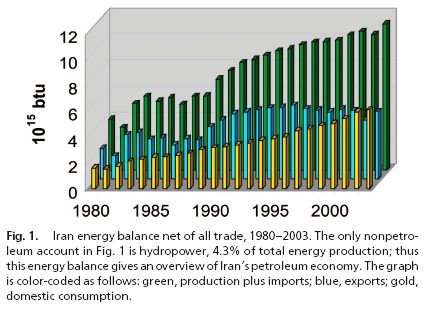
Trendline analysis is a very useful tool, so long as you don't fetishize on a single trend.  The global warming crowd seem to fetishize on carbon dioxide concentrations in the atmosphere, ignoring the overall point that the planet is in one of the lowest points for that in its entire history.  And when pointing at a miniscule century of temperatures, they ignore the 800 million year climate record found by geologists over decades.  Concentrating on the wrong scope, wrong numbers, wrong time-frame and, finally, ignoring that the data, itself, is being undercut by processing errors and instrumentation errors doesn't help.  When you want to analyze trendlines, like say Iran's oil production and its capacity to export, you not only have to ask yourself 'what do the trends signify?' but then ask yourself 'what are the things pushing these trends?'.  From Roger Stern's article released online at 26 DEC 2006 on The Iranian petroleum crisis:

You don't get the capability to leave things out, but as the idea of how to get oil out of the ground, transport it, refine it, sell it, and then look at marginal expansion are *all* far more than a century old (and since the oil industry is an offshoot of mining, that puts those concepts back thousands of years to the first human mining experiences) you do not get to wave your hands around claiming much and citing little.  A process of under-investment, over-utilization and subsidies on refined products all leads in one direction for energy use and the ability to export: the variables are known, the trendlines obvious and the ability to counter them requires years if not more than a decade.

When talking about a larger society, however, the trendlines are not in any one place: society covers a wide gamut of human interactions and trying to see if a suite of them has any sort of defining impact is difficult.  So, when looking at the trends of the US starting in the Vietnam era and onwards, I take a broader sweep of things, due to the inability to actually *measure* these trends in any objective way.  There is no thermometer reading for foreign policy or nationalism amongst a population, no wind-force scale for popular opinion to compare across eras, and no Richter scale to measure the impact of events on a society as a whole.  If there *were* I would use *them*.  So the empirical and 'high water mark' sort of evidence is necessary:

The death toll that accrued to America's unwillingness to stand for her values, stick by an Ally and retreat with mere scratches when entire societies were threatened was enormous. The media conveniently under-reported such things and so retreat was seen as a 'low cost option' against military aggression in far off lands. Mind you, the mightiest economy of the planet was expending less than 10% of its economy and more on the order of 8% to deal with this, continue a build up of thermonuclear weapons, heavily increase its industrial capacity, raise its standard of living by leaps and bounds, put a new era of agriculture in place that would further reduce the manpower needed to feed the Nation, and put forth new science and technology at a phenomenal rate. The USSR, meanwhile, was spending 15-25% of its economy on war material, creating substandard housing, inventing very little, and repressing its people continuously through secret police, gulags and imprisonment without fair trial for stating 'political dissent'. The layer of 'Mutual Assured Destruction' was used to cement the 'balance of power' in place and KEEP IT THERE. Those who had put forth that Foreign Policy had so inculcated the power structure of the West to it, that there was no other option ever put forth that got a hearing on trying to do something different. Grand Strategy had, indeed, become based on fantasy and those holding wonderful reports from the CIA in the late 1980's about how the USSR would be around at least until 2010 and most likely 2030-50 should have been seen as *frauds*: they had so weakened the Nation to respond to *any* attack and counter threats to the Friends and Allies of the United States that the US was no longer seen as a reliable power of any sort.

The loss of identity of the American People to its Foreign Policy strategy is not new. It is traced directly back to Korea and Vietnam where the disenchantment of the American People with supporting dictators, appeasing aggressors and, generally, giving up the ideals of Liberty and Freedom to a 'balance of power' that they started to walk out on the system ITSELF. By the late 1970's the mass movement of the American People was no longer along standard political and ideological axes, but was a growing disenchantment with the political system that would *support* the deterioration of National Sovereignty and the Preceptual belief in the Declaration and the limitation of Government seen in the Constitution. The end of the Cold War did not start this trend which was in full swing by that point in time. The American People believed that the Nation should stand up for some things and the political class was telling it that those things were not worth standing up *for* or doing anything to *continue* them. To have a sense of the lost security on the Global Scale one must first *start* with that sense which America has not had since the middle of the Cold War.

After Vietnam, the destruction of Cambodia, Laos, and the reprisals taken against South Vietnam were huge with death tolls as a result of American cowardice rising into the tens of millions. The USSR saw this as a vital way to undermine the West and the very conception of Western Liberty because their sympathizers in the West had shown an ability to redirect outlook away from Preceptual basis to one of 'no blood now for any reason, ever'. This was not helped by the US non-response to the overthrow of Iran by Islamic Fundamentalists, the botched hostage rescue attempt, the Embassy bombing in Beirut, the Marine Barracks bombing in Beirut, the Second Embassy bombing in Beirut, the Pan Am Lockerbie bombing, the Berlin Disco bombing... The continuous hit parade against the US and its Allies by foes both Communist backed, like the various 'Red' factions/legions and the Pan-Arab to Islamist groups led to further deterioration in the concept that the US would actually address anything outside of herself. The retaking of Kuwait was seen as a validation *of* that because the US would no longer dare to act *alone* in her own interests. And promises given to people wanting to over throw a dictator were not fulfilled and so 300,000 Shia Arabs died due to Saddam Hussein because they actually had this strange belief that the US would actually stand FOR anything it said.

Those are the trendlines of disenchantment of the American people with its government, political class, foreign policy institutions and, in the end, self-alienation from the concept of a Nation supporting liberty and freedom both at home and abroad.

A fertile place to examine how trends can be seen is via 'alternate history' or 'counter-factual history' which both utilize things that did not happen and then look and see what the ongoing trends across societies and nations were and how they would be effected by them.  This I did in my piece looking at how Azar Gat postulated a slightly different outcome to world affairs if North America was not that rich in resources or in any given subset of them (say fresh water or iron ore or fertile land).  A United States with the natural resources at lesser degrees or far harder to get and support would not have been able to sustain the industrial output necessary to fight two World Wars. 

Going a bit further, as I am an alt-history fan, I postulate an even smaller change to Germany pre-WWI that would have long-term and large scale ramifications globally... actually a trivial change historically speaking.  The overall analysis, however, is that of 'contingent effects' being predominant in history: things that are unrelated to societal trends, say natural resources or transportation lines, can impact a wide swath of peoples and the course of nations.  This goes against Marxist views of 'mass-movement historical trends' because those very same mass movements are based upon contingent effects.  Without the basis to get those masses, the movements either don't show up or they show up in a scattered way and exert little overall force.

With any consequential petroleum resources held by Germany and threat to take more of same, plus a stalemate in the Euoropean theater, President Wilson would be forced to put the economic needs of the US aside and join the Allies or to fully fight *all* of the Allies of Germany. There would even be the case made that supporting Germany so as to *influence* it and its allies was in the US interest for the long-term spread of democracy and liberalization of those regimes. That was a case hard to put forth with Germany relatively isolated, but a Germany with more resources and active in the Middle East then puts Germany combat expertise in support of the Ottoman Empire.

World War I was not foreordained to be the US coming in to save the Alliance bacon and then fouling up its handling of the Middle East for 90 years thereafter. With one relatively simple shift in outlook, one that the Kaiser could easily have taken umbrage to, the entire geo-strategic basis for World War I would have changed and harshly. If the Aussies had problems at Gallipoli with Ottoman Turks there, imagine the problems they would have with Germany supported Ottoman troops with more modern weapons and tactics. And securing victory against the Ottomans by the British from the south would have to be concentrated on attempting to regain natural resources and be faced with German troops attempting to isolate Persia and threaten Arabian oil supplies and other Middle Eastern natural resources. Not to speak of the Suez Canal.

One minor rail line that was discontinued but near completion just before the war, could have changed the entire history of WWI with the pre-war plans adjusted to that economic parameter: Germany was very capable of doing that.  The trends of war, in that case, would not be 'mass movement' affairs predicted by socialists, but highly variable affairs based on tiny accidents of history.  Some broader sweeps do happen, say the shift to agricultural societies, but the final forms of those societies winding up into anything like our modern world are not pre-ordained.  If the volcanic island of Thera had not exploded for an additional century, the movement of that early civilization based on Crete and Thera would have been able to thwart Mycenaean attempts to overcome them.  Without that you get no Trojan War.  Indeed, a more highly coherent multi-island society becomes a palpable force with time to spread and the entire history we know after the dawn of the Bronze Age would not have happened as it would shift Egypt and Babylon, too, via trade and intellectual discourse.  Given a century, that early civilization with hot and cold running water to individual homes, indoor siphon based plumbing and other things that would have to wait until Roman times, would have spread faster.  Greater public health via good sanitation saves countless lives daily, and is a simple thing to do.  With agriculture, sanitation and time to build up trade, our world would not be here as we know it... probably we all would be speaking some form of Greek.

That is a contingent effect having a mass movement outcome: it is a necessary mental tool for trendline analysis to be able to postulate a minor change (a change in outcome that is randomly distributed) so that a wider spectrum of subsidiary changes can be examined using our knowledge of how such changes have impacted other societies.  With that being said, when large scale trends do start moving societies, then they continue moving until something else acts upon them.  That is part of the supersaturation concept.  And my best trendlines are actually measurements, although they are direct, like the declining export capability of Iran, they are a bit darker because of what they are showing:

The above taken from US Census datasets.

Voting requires that one be over 18, a citizen of the US and not otherwise stopped from voting via previous convictions for crimes.  We have concepts, in a representative democracy, that include words with attendant ideas:

Majority - the majority of the voting population.

Plurality - a large segment of the voting population that is sub-majority, but not minority.

Minority - generally sub-plurality, to the point where it is non-competitive with a plurality, generally placed under 40% and usually under 30%.

For representative democracy, starting in 1964 for Presidential cycles, the Majority came out to vote in numbers that would allow the winners to claim Plurality status.  In the years between 1976 and 1992 the ability to claim a Majority voting is still in effect, but the resultant government could no longer claim Plurality status and can be considered a Minority with Majority voting.  These are given considering non-'landslide' elections where contests are in the 52% winner and 48% loser arena.  Most elections have been closer to 50/50 with the Nixon and Reagan 'landslides' the exceptions.  The historical trendline for Presidential election years has been downwards with a spike in 1992 and an upward trend between 1996 to 2004, but with 2004 being a high water mark for absolute turnout though a relatively low turn-out considering the 1964 high in that area. We have not had anyone who can even claim to be a Plurality President since 1972 with the sole exception of President Clinton barely clearing that in 1992 and then falling into Minority status in the next election cycle.

If all underlying societal circumstances remain the same over this period for commitment to representative democracy, then the overall trend can be said to indicate a drifting from utilization of the franchise right by a minority, at first, and then by a Plurality.  With the exception of 1992, the Plurality of Americans who can vote have voted with their feet and non-exercise of their franchise as a demonstration of their commitment to representative democracy.  Or in this case non-commitment to that concept.  That underlying trend, if it has no mitigating factors would then trend for the next Presidential election cycle to 'regress towards the mean' or average indicated by the ongoing trend downwards.  I examine that concept of how a mean or average trend via a slope in a graph depicting such things as batting averages, average temperatures and other things has a powerful mathematical backing to it.

Here the interim Congressional election cycles demonstrate the operative slope clearly, with the 1966 high water mark for Congressional turnouts being in 1966 with a slight fall-off in 1970, allowing Congress to claim Majority turnout but to be Minority in representation with close elections as an operative concept.  Starting in 1974 and with every subsequent interim election, there has been a Plurality turnout with Congress moving into pure Minority status for representation.  Dropping below 45% in 1998 and subsequently has cemented that Minority representation and would indicate a decided lack of support from the American voting population.  A slope on the Congressional graph, only done by eye and pure estimation, sees a 12% drop over 9 interim elections after the start of the graph or a general 1.3% drop per interim election cycle election cycle on the Congressional side.  A similar slope dropping approximately 20%, again done by eye, over 10 Presidential election cycles after the start of the graph yields a general 2% voter turnout decline per cycle.  Not having the 2006 turnout information handy for Congress I can't say if that holds up, but as there was no indication of a massive spike in voting that would draw inordinate media attention, the norm may have held.  For the next Presidential cycle that slope would indicate a 54%-56% turnout to return the turnout rate to its declining slope to its mean.

That latter is worrying as, to truly get back in synch with the slope, the amount of area covered by the variation would have to be made up by actually going under 54%.  If the mean has a draw to it then that would seem to be indicated, giving the highly spikey turnout changes in Presidential election years.  For that to happen, both parties would need to nominate individuals that would depress their own voter turnout and the turnout of 'independents'.  A 2% total percentage drop-off would be a minimum expected with a mean drawing the percentage back to historical turnout declines, while a 4% would be the average drop off (thus to just over 54%) and 6% would start to bring the overall trend back into line for a slight recover in 2012.  What happens at 6%, however, is that nearing the 50% turnout line starts to dance with the turnout rate changing from Majority to large Plurality.  A drop to between 50% to 52% starts to be a test of the actual adherence of the American voting age population to representative democracy.  For a representative democracy to claim any legitimacy under majoritarian standards, then a Majority must turn out for elections to be considered as 'representative'.  A slight drop to Plurality turnout then calls into question the actual validity of a representative democracy as representing the 'will of the people' when their will has been demonstrated by not voting. 

There is no 'out' in that function: if you believe in the concept of representative democracy, then there is no plea to 'only the interested vote' or the 'smarter people voting represent those who don't'.  That is patently not the case as the former is actually citing that representative democracy is not working and the latter is suggesting some form of authoritarian outlook by a Minority to rule the Majority.  The glib answers like that must end when representative democracy founders with such low turnouts.  If there is no interest in common government, then government is no longer able to serve the common man and must guess at what that common man wants.  And do notice that every social program, every educational program, every pork barrel project, every enticement, every bribe, every payoff to the people with their own money has not brought out more people to actually *support it*.

The longer term artifacts of this have been showing up in other, derivative data sets based on Congressional votes.  Looking at that in Running the numbers: Polarized America, I found the following:

What is more troubling than that, and being witnessed this election season, is the two parties fielding presumptive candidates that are, inherently, starting to cause party faithful to waiver. If candidates in both parties cause a minor drop in their own base participation, say 10%, then the percentage voting drops very close to 50%, just nudging over it by a bit. At 15% it drops just below 50% turnout. At that point representative democracy goes from plurality government to true minority government, representing a sub-part of plurality. Even with minority government status being reached de facto for many years, the absolute shift where true plurality of the voting age assent is given is no longer in hand.

Gridlock is actually not a problem but the solution being given by the political center in the US: it is the only ready means at hand to keep the two parties in mutual check so that they can not run an activist government. The ability to actually be wealthy and not have that pathway to wealth put in danger is a sub-marking point of the larger demographic shift by the center. As government is a user of wealth, not a creator of it, the political center is now saying to both parties that what they created during the Depression to mid-1970's is not what is wanted by them, and they are willing to let the two parties drift hard apart from each other by not participating in representative democracy. We hear much from the two party activists, but the quiet and dead silence from the middle is attempting to marginalize both parties into ineffectual stalemate.

For all the activism being seen, those very same activists ignore the fact that more and more people are no longer voting.  If said activist views towards government 'helping people' were correct, turnout would have been on the rise for the last four decades, and yet just the opposite has happened.  That growing Plurality is using its right NOT to vote as a negating power by pitting activists against each other into 'gridlock'.  If that Plurality had wanted *either side* to dominate, it would dominate, and yet we have 'gridlock'.  That 'gridlock' indicates a bankrupt outlook by the two parties that has gotten worse and continues to do so, on average, for every election since 1964.  There is also no support for 'bipartisanship' as the polarizing process has driven that out of the political arena: it has not served a purpose to this growing plurality and so it is nearly gone from politics.  Bipartisanship has not yielded something useful to the non-voting Plurality and so they continue to grow in numbers as more and more are turned off by 'bipartisanship' and party 'activism' for 'causes'.

As I said way back when: things in Iraq have good trendlines and have seen those increasing since 2006, while things in the US have been going downwards for decades heading into troubled waters.  You start to see this effect now being cited by a few others, like Ralph Peters in an article at the NY SUN on 28 JUN 2008, looking at the lies told by the political elite and the media about Iraq, terrorism and the condition of things in the US and globally:

Every single significant indicator, from Iraqi government progress through the performance of Iraqi security forces to the plummeting level of violence, has changed for the better - remarkably so.

If current trend-lines continue, it may not be long before Baghdad is safer for Iraqi citizens than the Washington-Baltimore metroplex is for US citizens. Iraq's government is working, its economy is booming - and its military has driven the concentrations of terrorists and militia from every one of Iraq's major cities.

While the US is trying to ignore a growing insurgency problem south of the US border.

Not that either of the two parties will address that, nor the spillovers that are now happening in the US because of it.  The first teams of hitmen roaming the Southwestern US have already started to arrive.  But 'activist' candidates won't address that.

Which is a symptom of failing democracy in the United States.

Wednesday, October 03, 2007

When change is not progress

The following is a personal outlook paper of The Jacksonian Party, cross-posted from Dumb Looks Still Free.

At the founding of the United States there was a clear and succinct voice that rang out beyond the great documents, beyond the Declaration of Independence. It was a voice of Revolution and yet a voice of warning, too. That voice with single clarity identifies, classifies and instructs on who we are, as a People, and how we view this world. It is a voice forgotten today, and many while noting the author, no longer note the words involved, as they were and are Revolutionary. Perhaps the best passage for our modern times comes from then, if we dare to read it:

Some writers have so confounded society with government,
as to leave little or no distinction between them
;
whereas they are not only different, but have different origins.
Society is produced by our wants, and government by our wickedness;
the former promotes our POSITIVELY by uniting our affections,
the latter NEGATIVELY by restraining our vices. The one
encourages intercourse, the other creates distinctions.
The first a patron, the last a punisher.
That writers is, of course, Thomas Paine and the quote is from Common Sense (via the Gutenberg Project), bolding is mine, unless otherwise noted.

A problem on the Left and the Right is to try and use government to enforce society, and social norms, instead of having government shift to our changing views as a People. Our society is given voice by who we are, what we want and how we approach life as a People. The government is an artifact of that process, made to ensure that our passions do not destroy our society, but not to enforce a view on the world upon that society. The major 'debates' of the last century revolved around the role of government in society, and in each and every case, MORE government intervention was chosen over LESS.

I have written elsewhere about the 10 years that changed the course of America for the worse, within that century. Starting in 1909 the US Federal Government expanded its powers over medications, to begin regulating what individuals could and could not do with their own bodies. Government put that forward via those organizations that supported them, mainly church groups seeing the ills of the Far East opium trade, and sought to end the trade by eliminating the demand. To do that, Nations had to agree to end the importation of such things and outlaw them for their peoples. The Federal Government, before that, could only tell manufacterers to list all ingredients in foods and medications, via the food and drug purity laws. That is how the government *should* act, so that the People have a truthful accounting of what they take in the way of food and medication. In proscribing certain medications to enforce a treaty, the Federal Government changed its role from that of supporting society to that of dictating to the greater society based on a religious outlook of ending the opium trade.

Instead of just taxing the hell out of the imports to try and dissuade Americans from using such things, the Federal Government went a route of authoritarianism against its own People to tell the People what was good for them. That was via the Harrison Act of 1914, to require 'stamps' for the purchase of these medications, and no stamps were ever produced or distributed. If you want the start of the 'Nannystate' then this is, perhaps, the first milestone in that. Would that such markers were so few and far between that they could not even be sighted one to the next. Suddenly a thing that individuals did, which was guiding their own use of medications, had become criminal behavior. Society could no longer be the patron of its own needs, and look after them, and government took up its role to punish those that contradicted that.

Also in 1909 would come Amendment XVI to the US Constitution that would allow the first formulation of taxation of individuals by the Federal Government to happen that would NOT be set by per capita tax, but by income. This would, in addition, remove the need of the Federal Government to go to the States to get income to run the Nation and allow the Federal Government to act in a fiscally independent mode from State based oversight. The 'power of the purse' for funding Federal Government shifted from the People and the States to the Federal Government. Previously the US had existed on tariffs and then asking States to make up the remainder based on an equal apportionment on a per capita basis. The States were left to figure out how the best way to garner that money was. Income tax, sales tax, property tax... the variety of taxes that could be levied varied and each State could figure out the best way to share the National burden for itself. The States, in separate or concert, could also WITHHOLD payments when Federal Government no longer addressed the needs of the States. That is an accountability power that Amendment XVI removed from play. Suddenly local government had lost its ability to hold the Federal system accountable to it, and the evils of local government were replaced by the distant and less accountable and larger evil of Federal Government.

Starting in 1911 would be the move to have the People directly elect Senators, and that would be ratified into the Constitution as Amendment XVII. This shifted a second, State-based, accountability factor from keeping Federal Government limited. While the appointment of Senators had always caused problems from the States, those were problems of localized, State based corruption that allowed the Federal Government to actually criticize the States for not doing their job of appointing Senators. A major question for democracy is: what happens when a major institution in a Republic is no longer strongly backed and yet is vital to the running of the Nation? The answer is NOT to change the place where the decision power rests, but that is what exactly, was done. Again, prior to this the Federal Government actually had to have its tenancies ham-strung by the States in their power to send or NOT to send Senators. If things are not getting done, perhaps it is the Federal Government's fault for not running itself well enough to gain backing by the States? Instead the People chose to move the corruption directly to themselves, so that Senators could now emulate their House colleagues in the ways of pork barrel politics.

Also in 1911 came Public Law 62-5 which would allow the US Congress to set a size that would be permanent, and no longer 'float' with the size of the population. That would have long term consequences which would remove from the House the need to address the changing size of the Nation and, instead, start to permanently divide the States into districts that would have a long range impact due to the shifting industrial basis of the Nation. The US was shifting from an agrarian system that was still the majority employer in 1911, to one in which manufacturing would be the major employer in the US in 1925. While the districts would be re-drawn to a degree to demonstrate that, those rural areas that had once had representation and would have retained that due to size of population in a proportion-based system, would now lose out in a fixed seat system. By amalgamating populations to craft new districts, distinction in populations on a rural basis was lost, even as cities gained more representatives due to the concentration of population. In a fixed proportion system with growing population, older areas that could retain their population base would retain representation, while in a fixed seat system they would lose that and need to have dissimilar towns and villages amalgamated into a larger district. The effect of that was not the marginalization of rural outlook, as it would be under fixed proportion, but the loss of diverse outlook from rural areas in favor of more homogeneous outlook based on dense, urban populations.

In 1913 the Federal Reserve Banking System would be instated, reversing the post-Civil War need for a Nationalized banking system for war finance and also reversing the veto of President Jackson on such a National Bank. In the system devised the Nation, as a whole, via its Federal Government is liable for its currency: thus financial obligations were now those of the Federal Government. This took the onus off of banks to have such equities go directly to them, but moved that responsibility to an unelected part of the Federal Government in the way of the distributed Federal Reserve Board. While this is a compromise, of sorts, to get some distributed representation into the banking system, it is not one that is directly accountable to the People and, instead, only by those passing appointment in the Senate as government officers. That is how the Federal Government controls currency and interest rates to adjust to financial conditions. In the intervening years from Jackson to Wilson, the main criticism of a Federal Bank was that it would be a majority ownership of overseas monied interests, which was the case with the First and Second Banks. While this system has prevented some 'bank runs' and alleviated 'bank panics', the question of the actual scope of government to do this is one that has not been well addressed. This is a change-over from a distributed, State integrated (or unintegrated as the case may be) system, being replaced by one of centralized control with limited district input. The accountability and tenure of such individuals appointed by the President and confirmed by the Senate is not one that has been or is well addressed. While it is, no doubt, a change that adds stability, the cost of that stability remains unaddressed by the concentration of that power to the Federal level and away from the States.

Amendment Amendment XVIII in 1919 would be the only part of this suite to be repealed, as the temperance movement and anti-alcohol movement attacked the very grain and fiber of the Nation and its history in alcoholic beverages. What is even more amazing is that the actual use of alcohol was already on the decline from its high point in the 1840's, along with a shift from hard liquor to beers and wines. The generations that built the railroads, built major industrial bases, built the first industrialized cities, built transcontinental railways, and united this Nation was a hard drinking rough bunch that accomplished great feats while, apparently, being sloshed to the gills. Somehow this was painted as a demonic or 'bad' thing, and the attempt to sever the Nation from its societal roots with intoxicating beverages went too far. The short term effect of that, however, was to empower the first of the international organized crime syndicates with the easily made and transported alcohol that had been outlawed. Those crime organizations had already started to grow based on opium, heroin and then cocaine, but the supercharging of those organizations by adding in alcohol made them the very first threat to civilization succumbing to well armed thugs since the age of piracy two centuries and more previous to that.

Each of these instances is an attempt to enforce a 'societal good' or an 'easement to government' that would, each in their own way, remove decisions from individuals and concentrate power into the hands of the corrupt and unelected on a National scale. These changes did not *stop* in that era, and, indeed, some were to come forward that would be even worse than the original problems in their long term corrosion of the society of the nation in favor of the government of the nation. I will look on that in a moment, but take time to look back to Thomas Paine, again, further on in Common Sense, where he proposes a new system for government, which is a striking outline for the House, Senate and Presidency we have today, and go further to look at what he saw as the basis for governance:
But where, says some, is the King of America? I'll tell you.
Friend, he reigns above, and doth not make havoc of mankind
like the Royal Brute of Britain
. Yet that we may not appear
to be defective even in earthly honors, let a day be solemnly
set apart for proclaiming the charter
; let it be brought forth
placed on the divine law, the word of God
; let a crown be placed thereon,
by which the world may know, that so far as we approve of monarchy,
that in America THE LAW IS KING. For as in absolute governments
the King is law, so in free countries the law OUGHT to be King;
and there ought to be no other
. But lest any ill use should
afterwards arise, let the crown at the conclusion of the ceremony,
be demolished, and scattered among the people whose right it is
.
Those words are one that became deeply embedded in America, and remain so to this day as a prime foundation of the Revolution and our own outlook on government and society. The law above all is that which holds us together as a Nation, even as we, as a People, see higher Divine inspiration above Nation, so that Divine Guide is not the guide of the Nation by mortal guise but is our personal guide to make good law for all People in the Nation. As Paine had pointed out earlier:
Not one third of the inhabitants, even of this province, are of English descent.
Wherefore I reprobate the phrase of parent or mother country applied
to England only, as being false, selfish, narrow and ungenerous.
The Colonies becoming States were already diverse in their populations, distributed amongst many sources and views on religion. That we had firm and steadfast belief in the Divine is not in question: that we each saw the Divine in a rigid way was in question. These States could ill-afford religious disputes here, and so the great Peace of Westphalia to allow each man his own view on the Divine was carried over. America has always had generosity in spirit towards all those who worship or not as they chose, but neither do we force religion nor irreligion on all. We pay homage to our roots in Divine Guidance, but then must get to the practical business of having a common Nation together with those acknowledged roots. We neither slather religion across those who do not wish it, nor do we remove it from those who gain offense to any homage to our forbearers. The Divine Inspiration for the Nation must lead to the hard work of making just law across society, and those that cannot understand that it was that Inspiration that made such things possible and pay no homage to it, break with the Nation as do those that seek to put in-place a singular view of religion for the Nation as a whole. Both are wrong and contrary to the Nation's history and discourse and corrode that common society that upholds the law, itself.

This Nation has suffered greatly over its time, but we also have a strength in society that is greater than the government itself. Even when things go horribly wrong, and many fall sick and die, this Nation had the resources without the Federal Government stepping in. Strange as it may seem, the Nation looked to itself for disasters, and saw government as the last and least competent to deal with same. The Spanish Flu outbreak did not cause a sudden need to have 'government mandated health insurance', and yet it killed hundreds of thousands in the US and nearly 25 million people globally in the first 25 weeks after its appearance. Those that tended to the sick were hospitals, church organizations, missions of various sorts, philanthropic organizations. Cities, counties and States responded faster than any 'National response' by the Federal Government could have done, as waiting to get those gears in motion would have killed more and caused more suffering than treating the ill immediately. America did, indeed, look to family, town, church, and charitable hospitals to seek aid and shelter from something that the Federal Government could do very little about either in prevention or direct aid.

After the 1906 earthquake in San Francisco, the Federal Government did NOT step in to rebuild the city. State, city and local governments along with industrial and commercial concerns all played their part in removing debris, demolishing buildings, designing building codes and rebuilding the city, which would suffer again and again from that form of natural disaster. Nor did the Federal Government do much about the Great Chicago Fire of 1871 or, indeed, a host of disasters both natural and man made, that would befall the Nation time and again. Apparently when a town or city or county or even the Nation is beset by ill or illness, the first place America looks, quited pointedly, is NOT the incompetent Federal Government. But those lessons were forgotten in the one 'ill' that had no source in Government and no remedy by Government. That would be the Great Depression.

I have looked at that era in a previous work, and will bring out some of the salient points of it here, to look at the appropriateness or lack thereof, of government intervention in such things as the economy. The most startling thing to realize is that the actual decline of the Great Depression was during the period of late-1929 to mid-1933, a bit under 4 years. Only one program put in place by President Hoover, would outlast his Presidency, and that was the Reconstruction Finance Corporation that would see its major spending in that period and then taper off drastically from 1933-41 until it was re-purposed for World War II. All of the 'New Deal' programs beyond that would actually come in the recovery upturn of the economy, without exception. None of them would be the actual cause of the turning point in the economy which was due to deep business restructuring and the start of re-utilization of industrial capacity. That did not, however, stop the adding on of new things to the Federal Government that had never been under its purview before.

The Securities Act of 1933 did not pass until the actual inflection point in the economy itself, and the follow-on Securities and Exchange Commission would not come until the recovery had actually progressed upwards from that inflection point. A raft of other works and jobs programs would face high hurdles and many fell due to SCOTUS rulings. That 'start-stop' concept that came about happened, apparently, in spite of industrial recovery and may not have been, in actuality, adding much, if anything to it. While many do argue that the work to make infrastructure, via things like the Tennessee Valley Authority, also in 1933, would add jobs and security to the infrastructure of the Nations' power supply and rural electrification programs, the utility and need of the Federal Government to do that have not been properly addressed. President Franklin Roosevelt, indeed, had a view that the Federal Government *owned* such electrical generation as water regulation as part of its make-up:
"Never shall the federal government part with its sovereignty or with its control of its power resources while I'm president of the United States."
The Federal Government, apparently, owns all oversight on all power generation in the United States, as seen by President Roosevelt. This is something of a 'power grab' by the Federal Government in both the power generation and direct accountability aspects to it. And as the TVA crosses many State lines, the Federal Government should have a part in regulation, but its role to actually build, run and maintain it are highly dubious at best. The sovereignty of the power resources of the Nation is for the People to utilize as they will, not for the Federal Government to take to itself. Control of the inter-State commerce part of that is up to Congress to decide, but those things that are entirely intra-State are outside of those powers, until Congress put forward that purely in-State dealings in things that have a National market allow it to use its inter-State commerce powers to regulate it. That was the basis of the Raich decision on 6 DEC 2005. Thusly if President Roosevelt was right, any Congress can put forward that all private means of power generation... say buying solar panels for your home... will have an impact on the National power market and thus should be regulated. Do not be surprised if one's own power production needs a meter on it to pay Federal taxes. That should make some individuals uncomfortable: that any means to address environmental concerns require obedience to Federal taxation for something that is free, like sunlight, being converted to electricity. Apparently sunlight can be put through a meter, and it isn't the power companies that can do it, but the Federal government.

One program that was never intended to live past the Depression era was enacted in 1935, again well past the point where the economy was recovering. That was the provision to provide of old-age, survivors and disability insurance (OASDI) better known as: Social Security. Here, again, is something that the Republic of the United States had survived without since 1776, and even with the easing of the Depression and the re-employment of individuals, there was little actual need to remove from the hands of individuals their own ability to provide for their future needs. While there were, indeed, many older workers that were suddenly out of work, that was also true of their younger counter-parts. The idea of OASDI was to remove the older workers from the workforce by a forced retirement system to get Social Security benefits. Unfortunately the first pay-out from the system was on 31 JAN 1940 not only well after the Great Depression had passed but also after the 1937 Recession which had marked the end of the Great Depression. Apparently older workers were *still* expected to undergo forced retirement and end their contribution to the workforce once the Nation was expanding economically before WWII. The post 1937 Recession recovery was robust and growing in its need for workers, with industrial expansion on the rise by the industrial sector.

The two premises of the OASDI system are deeply and highly flawed: 1) that the number of jobs in the marketplace is fixed, and, 2) that life expectancy is fixed. In the Depression these two things were forgotten, with the sudden decline of so many individuals having so little income to sustain themselves. Post-Depression, however, both of these proved false almost immediately with economic expansion going beyond pre-1929 levels of employment and life expectancy continuing to rise even during the Great Depression. Both of these had upward trends since 1900, with only the Influenza Epidemic having a number of years of decreased life expectancy. With those two concepts of Social Security sitting fixed, the economic problems that each would cause, cumulatively, now force this Nation to question the wisdom of having the concept of a 'retirement age'. Life expectancy increases, alone, mean a nearly 14% drop in the number of productive years one can expect to be working as part of one's life. Previous to OASDI, an average individual could expect to spend 45% of their lives in the workforce, and that does not include any time spent as children or teens working. Today the average individual can expect 31% of their life to be in the active workforce. That delta is paid for by transfer payments to the young, working class of individuals to the older workers who have retired. As life expectancy increases, although well below the absolute known limits for human old age, more of that time is spent not working and is subsidized by younger workers.

Strange as it may seem to say, most of the time America has existed was spent with people working to effective old age, and only retiring when they either could not work or their own plans for retiring had come about. The removal of letting an individual decide this and letting the Federal Government do so has been an increased dependence of older individuals on Federal payments and removing self-reliance from individuals to plan for their own old-age needs. Even worse is that the Social Security 'Trust Fund' is a revolving door account, in which no money is put into actual 'Trust' via securities and all payments depend on taxation upon workers. That is not 'Insurance' it is a direct income redistribution from struggling younger workers to older individuals who should be both older and wiser in their handling of their lives. Beyond that, the lack of investment due to the 'Trust' taxation means that income that would normally have either been spent or invested by younger individuals for such things as homes or old age security goes to those who are no longer working and should have prepared for this known eventuality in life: it is called 'getting old' and it is across-the-board and a well known phenomena.

It may have had some basis earlier on, when actually being able to invest widely was difficult for low income individuals, but that era passed with the entry of automated mutual funds for investing, and fractional stock ownership in such funds. While a relatively poor worker of the 1930's did not have such opportunities, that is not true of an entry level worker in 2007 and hasn't been true for a couple of decades. Today's workers no longer expect to *get* any payment via Social Security and plan accordingly with their remaining funds. This 'entitlement' was invented for a particular era and need and now has almost become a 'right' and the Federal Government had very little place or standing to do this when it did. In so doing, however, a real problem happened in the 1940's when numbers of individuals were ready to retire and they were needed for wartime production! As no good deed goes unpunished, this program was removing workers from the active workforce just as they were needed to replace younger men going off to war. To encourage those that would normally retire, a number of 'non-wage benefits' were put in place by businesses and one of them was given a tax write-off by the Federal Government: health insurance.

As John Stossel goes over in Bad Medecine (21 SEP 2007, NY Sun), insurance is the worst way to pay for medical care invented. Prior to the war-time subsidies via tax-code, Americans looked after their own health care directly. Most individuals went uninsured and some purchased forms of what today would be considered 'catastrophic care' plans, although most would fall under the 'accidental death and dismemberment' concept of insurance. Health insurance, itself, while not unknown was not widely used and the need for individuals to understand their own health limited the utilization of health practitioners and medications to chronic diseases or immediate ailments. It should be noted that even the Influenza Epidemic did not cause a rush to 'health insurance', even with the death toll that came with it. By requiring individuals to pay their own way, health care costs were minimized and, yes, often at the expense of long-term health. This did not prevent overall life expectancy to continue to rise even without 'health insurance'. Today the cost of overhead to the 'health insurance' system is entirely due to the 'insurance' part and not the health part. Actual costs to the individual for actual doctor treatment time and not paying for paperwork has changed very little in America. What has changed is the need to keep and manage health insurance records, fill out forms, undergo third party governance of what is and is not good for one's health and, generally, time and effort spent in trying to keep track of all of this. That overhead has now changed the system itself to a document management system that, as a minor function, also delivers a little health care.

When that tax subsidy did not end 'health insurance', previously a little used benefit for high wage workers, was retained and enrollment in it would swell. This causes a systemic distortion in two areas: 1) perceived cost when little payment is directly made for care causing spiraling cost as overhead increases out of proportion with delivered care due to fraud and over-utilization, and, 2) loss of control over one's own health. Both of these are hard to deal with, as 'let the insurance company handle it' has become the catch phrase, but one that indicates little understanding of the cost in 'letting the insurance company handle it'. Additionally the need to practice 'defensive medicine' and order many more tests than are needed to diagnose a condition, so that any malpractice suits will have little chance of standing adds burden into the system. Fraud not only by physicians but by patients that over utilize the system or who seek to cause an error to their benefit via lawsuit add into the expense of health care via 'insurance'. And as the number of procedures increase, the paperwork for each multiplies what has to be tracked by doctors and the insurance companies. To control over-prescribing of medications or fraudulent prescription of same, insurance companies now wield extra-ordinary power over an individual's health and will put down draconian limits on some medications that may be more expensive (due to their paperwork overhead, especially for 'controlled' substances). The result is that while many older medications may get under utilized, in preference to 'newer' and more expensive ones, individuals who need the benefits of the newer medications may not have access to them as insurance companies mandate more paperwork for justification for those newer medications.

Politicians who try to exploit these 'entitlements' or to try and create new 'entitlements' further distort the health care system towards their own ends, while not offering any improvement in cost, overhead or actual care delivery. By making such a system 'universal' and mandatory, the need for 'control' over the use and utilization increases, the overhead increases disproportionately to the amount of utilization and those that see no benefit in it (mostly the young and healthy) feel as if money is being extorted from them to no good nor useful end. We forget that for 'insurance' to be useful, the majority never get a real pay-out on it at any one time. Life insurance has a single-time payout and is a bet that you will die and the insurance company thinks otherwise. Similarly health insurance is your bet you will be sick in a given time period and the insurance company expecting otherwise. You purchase insurance to cover need and eventualities based on individual perception of those. Mandating same indicates that lack of trust in individuals to judge their own need and provide for it. That is government removing personal responsibility from the individual and putting it in the hands of a bureaucrat.

It is very strange to see such things, and yet, when reading Paine there is an eerie foreboding that one can get out of passages he wrote to describe the state of the Colonies just as the Revolution had begun:
The present state of America is truly alarming to every man who is
capable of reflexion. Without law, without government, without any
other mode of power than what is founded on, and granted by courtesy.
Held together by an unexampled concurrence of sentiment, which,
is nevertheless subject to change, and which, every secret enemy is
endeavouring to dissolve. Our present condition, is, Legislation
without law; wisdom without a plan; a constitution without a name;
and, what is strangely astonishing, perfect Independance contending
for dependance.
The instance is without a precedent; the case never
existed before; and who can tell what may be the event? The property
of no man is secure in the present unbraced system of things
. The mind
of the multitude is left at random, and seeing no fixed object before
them, they pursue such as fancy or opinion starts. Nothing is criminal;
there is no such thing as treason; wherefore, every one thinks himself
at liberty to act as he pleases
. The Tories dared not have assembled
offensively, had they known that their lives, by that act, were forfeited
to the laws of the state. A line of distinction should be drawn, between,
English soldiers taken in battle, and inhabitants of America taken in arms.
The first are prisoners, but the latter traitors.
The one forfeits his liberty, the other his head.
Legislation without law, a Constitution without a name, independence contending for dependence, the property of no man secured, nothing criminal and no such thing as treason... that is, unfortunately, an apt description of much of America today.

We have seen this before in America.