Showing posts with label representative democracy. Show all posts

Saturday, August 13, 2011

What we have gotten wrong about the war on terror

The following is a broad brush analysis paper of The Jacksonian Party.

This is a multi-part hat-tip, first to Instapundit linking most recently to a piece by Abe Greenwald at Commentary Magazine on What We Got Right In The War On Terror.  He had also linked to this piece by John Podhoretz at PowerLine which also links to the Greenwald article, but can no longer find that quick link from Instapundit.

To be up front, I am not going to do an analysis of the Greenwald article, because we have gotten many things right in the war on terror.  As an example the employment of police methodologies to go after terror cells in places like Iraq was first implemented in that war for finding Saddam Hussein, but has proven an excellent tool for in-group analysis to find out who is connected with whom inside and outside terror organizations.  The United States Armed Forces have proven to be the most flexible and dedicated armies ever seen on this planet and have proven a very hard adversary for in-country terrorists in the theaters of war we are engaged in: Iraq, Af-Pak, Philippines, Colombia, Kenya.

Other major pluses include:

1) The use of UAV/UCAV platforms to go after terror cell sustainment and after higher terror organization leadership.  Pinpoint attacks to remove supply lines run by small groups and to go after higher level operatives of al Qaeda have proven quite effective.

2) Utilizing SPEC OPS forces to take down 'tough nuts' and to serve as intermediaries to local populations prior to the introduction (or re-introduction) of regular armed forces.  Their stories in places like the Kurdish areas of Iraq, Anbar Province, and the border highlands of Afghanistan will not be known for years if not decades, and yet their effects are enormous.

3) Interoperating and cooperating with INTEL organizations by the military so that military forces and the 'shadow warriors' have a means to exchange information and utilize each other's strengths are, like the SPEC OPS forces, stories that will remain untold but their effects to help find the outside and inside actors for terror organizations is one that has proven effective time and again.

4) Moving from 'set piece' military ready for a 'two front major conflict' to an adaptable and responsive military as a system is something that is so overlooked that it isn't even mentioned, and yet the military organization on the ground, today, is not the one we started out with. The legacy of Gen. David Petraeus and the utilization of modern communications and data exchanges by the US Armed Forces have now tightened an entire loop of doctrine, training, and results analysis from years to days.  This is a revolution in military affairs, yet little is spoken about it.

5) The very basic thing of recognizing that al Qaeda is a threat and that for all that it is a very lightly funded organization, they utilize their limited resources to great effect.  Going after such an organization is not an easy task and yet our Armed Forces have shown us key weaknesses not just in their structure but in their sociology and inability to adapt to even modest differences in tribal cultures.  The early imprint of African tribal cultures stuck with al Qaeda through its early years in Afghanistan and then that was still applied to places like Iraq.  To this day we still hear of how al Qaeda doesn't work to 'fit in' and, instead, utilize terror and killing to force themselves (often literally) on civilian populations.  After being around more than 15 years in three major cultural regions with highly variant views on tribalism one would think that al Qaeda could adapt well, and yet they have not adapted at all.

The list of successes goes on and on.

There is a problem with such lists, however.

What is described is a Grand Tactical vision of success, not a Grand Strategic one.  Some of my earliest writings ask for just that: a basic Grand Strategic set of guidelines so we can know what it is we must do to WIN.  I put down some of the very basic things that are required for a victory in Goals in the Global War on Terror (25 FEB 2006), and thought them relatively common sense strategic venues that were at once asymmetrical and descriptive of what is necessary to seriously address the problems of Transnational Terrorism.  Someone had to at least post something like this because no one was putting that strategic vision forward.  And that has remained the case to this day and is one of the most painful things to say because it is blindingly obvious and yet none will speak of it.

Why is this important?

To use the military cliche: 'Amateurs talk tactics, Professionals talk logistics.'

All the lovely Grand Tactical stuff must have a deep seated Grand Strategy with active goals in mind or else, at the end of the fighting, you have won  nothing.  To fight against an asymmetrical power on the logistics front one must pursue their logistics supply chain.  That doesn't start with a jihadi and an AK-47 terrorizing a remote village in Afghanistan, it starts with where the money came from to recruit the jihadi, train the jihadi, transport the jihadi, infiltrated that jihadi in-theater, clothe and feed the jihadi, and then get that jihadi to that village to fire rounds around shouting 'allahu akbar!'. 

Your spelling may vary. 

For all the lovely tactical kills our Armed Forces have done, there has been very little done on the strategic side.  For all of the great talking points of protecting America from attack since 9/11, we have had the Ft. Hood shooting and at least one plot festering against Ft. Dix.  We have also had a group from Trinidad & Tobago plot against JFK airport in NY, and the attempted missions to get into the US for New Year's Eve bombings.  More worrying still are the jackets found in the US SW desert areas that are from Egypt and indicate al Qaeda training organizations, and as very little has come up from that realm in the way of al Qaeda espionage/financial groups, the concept that the US will remain terror-free is misguided.  To this day we still do not do a full 100% cargo inspection verification for cargo ships coming to our shores, and all it takes is one 'dirty bomb' (radiation, biological or persistent chemicals) to ruin the economic balance of the US by removing just a small percentage of critical transportation transfer areas at one harbor.

It is indeed wonderful that we have degraded al Qaeda's operational capability since 9/11!  But then it had spent a decade working up to that and the organization still remembers some of its skills necessary to operate with less in the way of operatives and support.  Killing off the veteran combatants is a huge plus, don't get me wrong, but for all the documents and such we have gotten to show how they work from the inside, we still have not addressed hemming them in from the outside.  This sort of thing works pretty well with organized crime because they must restrict themselves to a very few venues and set of operatives due to their internal trust-relationship system. 

Terrorists, however, get backing wherever they can, which includes far more than Nation States, and includes religious tithing, terror taxing, smuggling of illegal goods, trafficking in semi-precious stones and metals, extortion, murder for hire, charity front groups, semi-legitimate establishments in the goods production and retail systems, bank and credit card fraud, tax fraud, wire fraud.... estimates of the amount that a larger organization like Hezbollah gets from non-State sources (mostly Iran) ranges from 40% to 60%.  Because we treat many of these venues as merely 'criminal' in nature, we do not apply the Laws of War to them when they are put in place to support terrorist groups.  And it is this disconnect that is the main thing we have gotten wrong on the war on terror.

Social Fundamentals

I didn't know it when I started blogging, but the #1 item I kept on coming back to was 'what is terrorism?', and not just in the suicide bomber sense or the religio-/politico-/communist-oriented variety of 'justifications' but the actual activity itself.  Here is where the internal opponents of Western culture, namely the political Left, supplied the clue as the main talking point they put forward on terrorism is that it is only a 'tactic'.  When you are talking tactics that involve killing people then you are talking 'war'.  Yet this was not a conventional style, 20th century war nor even something that we normally saw in the latter half of the 19th century, but something a bit different from the wars we all got stories about.  The great deficit of the modern Left is the intellectual lack of curiosity and lack of mental rigor to actually carry their invective and slurs to conclusions and, instead, use them as facile talking points to corrode common education and understanding of what it means to be civilized.  We could not forget what terrorism actually is as an activity if we had not had it so often compared to legitimate warfare of the Nation State sort.  The lack of traditional, 19th century education of the 'shelves of vital books of civilization' sort, came to an end with the adoption of bureaucratic departments of education that were no longer based solely within districts but put political hands in control of much funding at the State and then federal level.  If you cannot have the intellectual honesty to state what form of war 'terror' is a tactic in as practiced by 'terrorists' then, really, you are only spreading ignorance and reinforcing it, not dispelling it.

Up to the US Civil War there was a deep understanding of this type of warfare and what it means due to the Barbary Pirates and the US use of Privateers during the Revolution.  The simple upshot of it is that Terrorists are Pirates.  Now that does beg the question of: what is piracy?  Here is a question that has actually been answered throughout human history and it is revealing that 'piracy' has very little to do with rum, parrots, peg legs, eye patches, or even ships, although ships have served most often as a platform for piracy, there have been many pirate armies (also known under many names like 'army of thieves') that do the same thing on land and have always been treated the same way with minor allowances for the lack of law outside of ships on the High Seas.  That is a wider view of terrorism, and it goes far beyond men in robes with AK-47's spraying bullets around hoping to hit someone other than themselves.  No, this stuff goes back to the beginning of recorded history and we do have the records to demonstrate just what piracy is and how it is performed and what form of warfare it actually is.

From all of this we find that piracy, terrorism, and all those who wage war outside of the Nation State or sovereign grant are fighting the most horrific kind of war possible: Private War.

Almost all of our great war stories come from that other venue, Public War, of Nations warring on Nations after declaring war on each other.  By not examining the more horrific kind of man against all mankind, we have blinded ourselves to the simple fact that war isn't something waged by Nations but comes from the heart of man and that civilized man creates government so as to regularize and restrict warfare, and that by agreeing to those restrictions we are allowed to exercise our positive liberties to a greater extent and build society thereby.  Our Negative Liberty we put into the hands of government for self-defense of our society, and we agree not to exercise it as individuals so that we may actually have a family, have a community and create a Nation in doing so.  Any who attempt to blur this line, and it is the most necessary line of keeping man civilized that we know, is trying to bring down civilization by equating unrestricted barbaric war with restricted and accountable Nation State war.  This first major line for mankind isn't drawn on treaties or maps, but in the hearts of men and when one agrees to not wage war without grant by the organ of society known as government, one agrees to act in a civil manner towards his fellow man and men of other Nations who do not attack him.

If we cannot fix this fundamental and self-evident truth in our minds, then all that has led up to our culture, our time, and our being here will crumble in the face of unrestricted Private War which is accountable only to the Laws of Nature, red of tooth and claw.  The fight to retain what is civilized is nearly lost in Western culture and is only strong elsewhere only where it can be enforced by something other than clans and tribes.  This is what we fight in the Af-Pak theater, the personal war contingent of strong tribesmen which are called Lashkars.  A Lashkar is a group of 3,000 to 5,000 fighters (or more) that are loyal personally to a leader and, usually, his tribe.  Our historical equivalents are the Gers, the Gauls, and the Scots amongst many hundreds of cultures in our own past that have practiced this most primitive and brutal kind of war via warlords.  That is where the name 'warlord' denotes and it is a proper usage for those not wishing to be held accountable via a governing system but rule by war and terror.

There it is again: terror as a tactic.

'But, but, but... Hiroshima!!  DRESDEN!!!'  I hear the hue and cry from the Left.

There is a brutal logic to Total War, that is war done by industrialized States against each other and it goes like this.

-  An Army or other military force is a representative of the economic capacity of a Nation to field such a force.

-  Economic capacity does not start on the battlefield, but the Laws of War trace that capacity back along the supply chain to the producers of those goods for a conflict.

-  Any organization or individual taking part in that support is taking part in the war, and the infrastructure to produce war goods is a prime and vital target of industrialized war.

-  You warn the population that these places are targets and that civilians should get as far away from those targets as they can for their own safety.

The UK dropped leaflets before they were even properly engaged in World War II to tell the German civilians that if they lived in those cities and areas supporting such war industries that they were in a target zone and should leave for their own safety.  The US also did the same there and in Japan.  Mind you this is more than similar populations have ever gotten in other wars all the way up to the 19th century and you don't have to reach far back to get to Sherman's march across the South and to the bombardment of armory cities in multiple wars in Europe.  That is the irreducible logic of warfare in the modern age and it is brutal and yet fully understandable.  In contrast Germany did not do this with the USSR nor did Japan do this with China, Philippines, and other Nations in the region during World War II.  The rape of Nanking by the Japanese and the wholesale slaughter of peasants by the Germans in the USSR are likewise representative of the absolute brutality taken on civilians in captured territory who do not have the capacity to wage war or support it which is against all codes of civilized war and those armies had reverted to pure savagery.  That is not the case with the various firebombings and nuclear bombings done by the UK and US during that same conflict as that was waged against targets fully engaged in war support. 

None of this can be equated to individuals and unaccountable groups willing to strike anywhere, at anytime, with no warning and no just cause and no sanction to their cause.  To do so is to dismiss civilized behavior in the brutal arena of war and by putting accountable actors between ourselves and that waging of war, we agree to the limits necessitated by those actors we put in place and restrict our actions to what those actors agree to on our behalf.  That is what it means to be civilized, in case it has been missed.  Part of the brutality against Germany and Japan was done in response to the unregulated and highly illegal methods used against captive populations by both Nations that violated all sense and sensibility of how to fight legitimate war and achieve its objectives while sparing the innocent.  For pirates and terrorists there is no thought of sparing the innocent as the innocent are the target.

Military Fundamentals

If the conflict in Iraq has been 20th century conventional, the war in the Af-Pak theater has been anything but that.  In Iraq pulling down a dictator, performing Counter-Insurgency (COIN) and helping the locals to establish a new government system is one that goes on well trodden paths because Iraq has had some background in what it means to be a civilization and culture, even if their country is relatively recent as these things go, their cultural heritage is ancient.  That heritage is being part of the cradle of civilization between the Two Rivers and while composed of a very tribal based ethnic system, the habits of being a Nation are deeply ingrained.  While still not up to where Western standards were circa 1900... of course we aren't up to those standards, come to think of it... Iraq has the benefit of having civilization start and collapse so many times over 6,000 years that this recent is a mere hiccup in that chain of comings and goings.  The only difference this time is that the outsiders are from further away than the Khan's armies and share very little with the Iraqi people as a basis beyond being controlled by Britain for a time post-WWI and, before that, having the Romans march around a bit, and then before that was Alexander.  You can sum up most of Western culture there: Alexander, Rome, Britain, United States.  At least the people there actually agree that having a Nation is a worthwhile endeavor.

Afghanistan only had brushes with Alexander and Britain and, of the two, the respect for Alexander is still sung about by tribal bards to this day.  If Iraq was a limited but recognizable modern war, Afghanistan is something out of the deep past of mankind.  The basis for a government in Afghanistan is a tribal based Parliamentary system that has counterparts in ancient times in Scotland, Gaul, and amongst Germanic peoples.  In this scenario a Nation is a generalized cooperative effort that takes secondary status to internal disagreements and divisions.  Cultures in Afghanistan remain tribal and they fight war on the tribal and Private War basis with minimal accountability for anyone involved in them, which creates long standing disagreements and feuds lasting... thousands of years.  While there are some deep feelings of support for the generalized Afghan culture and its heritage, that tends to be both in the artifacts of it and the rivalries still played out amongst the tribes as a living form of testimony to how enduring this semi-civilized state can be.  Afghanistan has seen ruling Nations and Empires come... and go... USSR, Britain, Persia, Genghis Khan... and that is just keeping it to recent history.

Fundamentals of warfare account for logistics, first, as there is a stark difference between putting a soldier anywhere on the planet and doing that and keeping him supplied with clothes, food, shelter, warmth, and all the vital necessary parts to run a military operation.  Getting a soldier in and out is tactics, getting him there for a long-term mission is logistics.  Both Iraq and Afghanistan have logistical problems for the US.

In Iraq it is the problem of having one vital sea access that is tiny, and has a potential belligerent (Iran) on one side of it.  There is no overland route that is secure from, say, Turkey to Iraq as the Turks made their displeasure clear about our offensive operations just before they started by revoking the US logistic support to attack out of Turkey.  Likewise we can't secure real overland supplies via Israel through Jordan due to the problems in both those lands.  KSA is problematical and while it would do nicely for enhanced port use, there is the sticky problem of causing unrest there and increased support for the terrorists we are going against.  There is a major crying need for a second supply chain system for operations in Iraq.  Still any shoreline that can get you to ocean-going vessels is better than none.

Afghanistan has none.  Our supply lines come through two ports in Pakistan which has been semi-bribed to semi-less belligerence, and at times one or both of those supply routes that carry 90% of the supplies for our forces have been interdicted by al Qaeda aligned tribes.  The rest comes in by air over Pakistani airspace.  This is not a good position to be in, particularly when in a land of warrior cultures who have been warrior cultures longer than all of Western civilization and, indeed, before the Jews differentiated themselves from other Ugaritic tribes.  What is totally disheartening is that examples in the past with overland and sea-based supply routes have failed: the Brits and Persians.  With a huge overland capability but weak economy, the USSR failed and fell on its sword in Afghanistan.  All of the past examples, save one, have had far more robust supply chains than the US has in Afghanistan today.  That singular one may point to a road to success, but it is not anywhere close to the road we are on.

That singular, though short-term success, was done by an Emperor putting together an Empire and having it fall apart with his untimely death.  He was Alexander the Great and he took out the territory we know as Afghanistan, today, by fighting with a lean force with a long, long, long overland logistical supply chain that went all the way back to Greece but was supported by conquered territories along the way.  By the time he got to the region he had a compact group of veteran Greeks and auxiliary troops he picked up along the way from other lands.  The Afghan highlands must have reminded him a lot of Macedonia, save with less water and colder climate plus the soaring daytime temps in the summer.  With a modicum of forces he fought as the locals fought, save better, by staging night attacks on citadel fortresses on mountaintops with just a handful of men.  He did the impossible and not only fought in a way the locals understood but fought them harder and better than they could fight him.  In solidifying the supply chain he laid down changes in language that can still be traced across the map today.

The problem with being supplied through hostile territory has a remedy: get a second supply route in place.  The United States has tried, and failed, to convince the two regional powers of Russia and China to help us on this, and that is a failure of diplomacy to support our mission in Afghanistan of the highest order.  With that said there is a third route to go and that is through Turkmenistan across the Caspian Sea to Azerbaijan and then through Georgia to the Black Sea.  This would take the creation of a diplomatic approach to weave between Russia and Iran to create a new mixed mode supply system that would parallel that of Alexander the Great who used an overland supply route.  This would be a geostrategic move, as well as it would put US interests across supply routes that are plied by the Russians to aid Iran, and yet remain neutral to that support.  There might need to be a rail link created between Azerbaijan and Georgia, and some reinforcement of their ports plus that of Turkmenistan, yes, but that would be a benefit to those Nations in supporting us and would give a relatively unhindered trade route across that system that would then open up Central Asia to increased trade with the West.  Each of those Nations involved would understand their importance to such a vital link, benefit from it and also know that while each of them hold it hostage that is a mutual system and to keep it open they would require diplomatic ties separate from those with Russia.

Government Fundamentals

No matter what part of the political spectrum you reside in, the lack of understanding that war must be supported is a key concept that has been held by all Nations, at all times save for the US in recent decades.  When the Nation supports a war it wins, when it doesn't, then we fail with much blood and destruction and little to show for it.  That is not just destructive to other Nations, but it is an abdication by the people of the United States to support the National interests as expressed by their political representatives.  In a representative democracy the will of the majority is what governs and it has respect for the minority to hear out opposing points of view and then attempt to craft policy that still reflects the will of the majority and takes into concern the minority.  That does not mean that the minority gets its way, but is part of the process of governing in a civil fashion and that the respect shown by the majority to the minority, no matter what part of politics it is in, that the minority will then exercise reciprocity when it is in the majority and the roles are reversed. 

In the last 50 years on military and war policy it is the minority that has been lobbying for veto over the will of the majority even when that will is expressed across political lines.  Protests for civil rights were solemn, respectful and those doing such marches expected much pain to be suffered by those doing the marching as they were making a moral and ethical comment about society and government.  Those protesting wars, however, have moved from one or two mass rallies that were semi-civil to events where costumes, bands, puppets and sloganeering against the majority have been the norm.  In that latter part of putting slurs against the majority and then adding that in to protests then makes the protest about the people doing the protesting and not about the object of their protest. The sentiment that is being expressed is not a civil one of wanting to work in an agreeable fashion to see if some sort of accommodation can be made so as to change strategic objectives so as to bring a faster end to the conflict and yet still achieve National goals, but to make the protest about the protesters alone and to put forth a concept that it is their way or the highway.  When that is done civil society is corroded as those protesting seek to put themselves above the will of the majority and dictate to the majority just what is 'right', what is 'fair', and what the majority 'must do' to satisfy the minority.

Worse, still, are the politicians who seek to co-opt such self-serving organizations to their own political ends.  At some point protesting against war is lost and protesting to support pure political, not national, goals is put in its place.  Only when both political parties are in disrepute do protests evince any sincerity, but even in those cases the co-opting of them by political factions continues so that the message by them is then harnessed to other messages which the protesters are seen as supporting by their silence to those other messages.  Supporting an end to a conflict is an end in itself, not a means to 'global peace' or a mask to hide 'global revolution', and yet we see little to none of the sincere protesting and much of the willingly co-opted to have their message diluted away by those seeking political ends alone.  At that point those doing such protesting are no longer supporting a representative democracy but are putting forth that they are an elite structure who see themselves as more able and fit to rule than the majority is to govern.  This message has been reinforced by glib and patronizing snippets of quotes from larger texts taken out of context of original document meaning and that has been slowly inculcated into the school systems of the Nation via political operatives working on the same platform as those co-opting the original movement.  That is neither honest nor in support of the ideals of representative democracy to run a diverse Nation State and is, instead, trying to place down fundamentals of an authoritarian or totalitarian state against the wishes of the majority.

War is a serious business as it is something on the Public side that requires open support and acknowledgement of the Nation State even when you disagree with the policy in question.  When attacked the population is to acknowledge that it has been attacked, to seek redress against the attackers and then prepare for war.  Not be told to go shopping.  The political elite has made war optional for itself since the 1950's.  First it has gotten politicians to put in exemptions into the previous draft so that those going to college or otherwise involved in certain affairs of life that are not open to the many save via deep finances, are given a waiver on being drafted.  Those people feel they should be exempt from the common burden of warfare.  The remedy in a Nation of free people, is to make military service voluntary and doing that during the Cold War required a fast and hard restructuring of the military system that must still retained cohesive capability during that transition period.  As the Armed Services of the United States had done this after two previous conflicts with widespread conscription (US Civil War and World War I) the lessons of those eras were retained at the War Colleges and a properly re-scoped and yet capable force took a mere decade to cohere.  As the service is voluntary, it takes commitment, courage, skill and knowing you won't get paid much for the privilege and for the sacrifice you offer to your Nation. 

The elite establishment then worked to isolate themselves from that by throwing off ROTC recruiters from campuses and not offering military recruiters spots at job fairs. 

Pacifism is not sustainable due to the nature of man, which comes from the Law of Nature and what it offers is not a viewpoint on the morals and ethics of war but now gains a following that seeks to denigrate war and then be unable, like prior generations of pacifists, to support their Nation during wartime by offering their bodies and time to the Nation, often for the hazardous privilege of medical experimentation or as in-theater combat medics.  That is a deep and honorable way to be a pacifist and shows a moral and ethical commitment to the Nation while retaining complete adherence to one's beliefs.  Modern pacifists are, sadly, just anti-war and seeking to excuse themselves from any commitment to their Nation by not volunteering themselves for the same sorts of hazardous experiments that are still available to further the cause of helping mankind against disease which is a common enemy to all peoples.  Instead of commitment to Nation they are told to go shopping, become more isolated from the Nation and let their 'betters' handle things for them... so that they can then protest the very few willing to sacrifice their time and lives for the Nation and make it a worse place to come home to instead of a better one.

In that elite class which spans across political, economic and even military lines, there has been a loss of understanding that wars must have this thing known as objectives.  These are the concerns that sets the Nation to war and are the point of making war.  A clear and succinct set of objectives are necessary for successful war-making so that the Nation removes threats to it in a long-range fashion.  To go after these objectives requires a grand strategy which are the major goals that must be gained militarily to meet the requirements set by the objectives.  The grand strategy dictates war doctrine, which is how the war is to be fought and the venues it must be fought in to gain the objectives.

A very simple thing to ask, then:  what are the objectives of our involvement in Iraq and Afghanistan?

The answer lies within the Congressional Authorizations for each of those conflicts and therein lies the problem.  For Iraq, alone, there are 23 points (if memory serves) that need to be addressed as objectives and some of them, like removing terrorist influence inside Iraq, are so nebulous that they cannot be achieved.  A President, who is Commander in Chief, is to then boil these Congressional objectives down to a grand strategy with the help of his military advisors, so as to put down a hard set of goals that can then be achieved so that when they are met the war is over.  It is then his duty to tell Congress what can be achieved and what can't be achieved, and he will carry out what can be achieved and leave further debate on those that can't be achieved up to Congress.

We the People of the United States have not gotten that from two Presidents.

That is an abysmal failure in our government and the elite class, both, in that they cannot understand the fundamentals of war and why we go to war.  This is true across the Western World at this point in time.

The horror of not knowing the difference between Public and Private war is extreme and deep.

Not knowing the functions of legitimate Public War is to invite the public to become barbarians, directly, and accept war as a thing to be done for any reason or no reason at all so as to follow the leadership of a blind and self-serving elite.  An elite who don't understand that it requires a civilized society to have such a large number of elites and that if the society goes down around them, then their status as elites, their money and, indeed, their very lives don't matter any more.  That is a direct outcome of elite propaganda, protestors and transnational movements that co-opt those venues and spread ignorance that is self-serving to its goals.  The ignorance isn't just in the general population but in the elites, as well, as they are members of society and they are not exempt from the trends and direction of education as the educational systems are compromised on a wide scale in the Western World. 

Is war a horror?  Without a doubt but there are differences between Public and Private war and legitimate and illegitimate Public War that have been known for centuries and before the founding of the United States.  We no longer teach this stuff.  And yet that is the basis for having personal relationships as we must understand that we must put aside personal violence to live in a civil society and then use our will as a people, when necessary and no other venue is open, to have redress of grievances against other Nations addressed on the field of battle.  War isn't the last resort nor is it the first, but it does fit in the top 5 after negotiations fail and then one last attempt is used to have an opponent see reason.  Put it at about #3 for all practical purposes as good faith must be shown and turned down more than once, but by the time you get past 3 times you have lost the will to actually have a functioning Nation.  Soon you will stop teaching your children about what Public and Private War are and the differences between legitimate and illegitimate Public War.

So after 10 years from 9/11 are we actually getting some things right in the war on terror?

Yes, undoubtedly.

It is unfortunate that we aren't doing the necessary things to make plain and clear that all those achievements have an objective in mind.  And if you are going to actually mean what you say about fighting terrorists, then it doesn't stop with al Qaeda and that organization isn't even a waypoint to the larger set of objectives if you mean 'war on terrorism'.  To fight terrorism you must have a society that understands what it is, why it is illegitimate, why it is a danger to all Nations and then have plain and simple laws available to deal with these enemies of mankind that cannot be misunderstood via pages of verbiage but made plain in one to two sentences, which include the penalty for doing it.  Unfortunately we are not serious about this war, and because of that no matter what the achievements are, we are on the path away from victory because we do not mean what we say, because we can no longer understand what it is we are saying.


Sunday, November 23, 2008

The Citizen and representative democracy

As a people we recognize our in-born, self-evident and inalienable rights and liberties as individuals to be those granted to us by existing in the Law of Nature. We give up some few of those rights and liberties to exist with our fellow man as citizens. That thing is called 'society' and is the basis for commonality amongst men, even if there are different ones across the world, the ability to put a few rights and liberties and invest them in society gains the benefit of common work done to the benefit of all, and the removal of wasted time and energy by helping our fellow man to survive. As animals have done this since the first schools of same back 400 million or more years ago, doing this gains a positive feedback for the individual: It feels good.

That needs no higher piece of explaining or logic behind it, but there is a purpose to 'feeling good' in helping your fellow man or achieving for yourself. It is a self-reward that reinforces society and organisms in society to help all of society to survive by lessening tension amongst individuals by allowing selfless acts to gain an internal reward and, often, external praise. Do note that not everything done that makes one feel good is praise worthy, but those that gain social appreciation become stronger for the praise of those one helps and your fellow man. As we have seen throughout history there is no guarantee that the actual activity is, itself, 'good' or 'nice': Aztecs cemented their society together with blood rituals which were necessary to appease their gods, Romans indulged in self-fulfilling debauchery that was supported (for a time) until the general decay of the Empire turned that into a counter-survival concept. Society, itself, is our investment of ideals and a modicum of liberties and rights to ensure that those ideals and beliefs are passed on, that is a neutral system with positive feedback: it ensures the state of beliefs but does not ensure the longer-term survival of them. Many a 'good' society has been over-run or lost to history, from those who were wiped out in the Aegean who had achieved hot and cold running water and sewer system for homes to small communities of Christians that wanted to directly believe in God with no intercession of any Church or authority, save God's, their ability to survive was not ensured by their society and how it fared with outside events.

From these events we gain wisdom that a stronger thing is needed to support society, and we invest more of our negative liberties in that man-made construct so as to protect that society. That thing is called a 'State' and serves as functional unit for discrete societies that are seeking furthered survival. States are unitary, by and large, they have a single society either via ethnicity or commonality of single place with single society, such as a City, as their focus. An outgrowth of a single, dominant and expansive State is one that attacks and conquers surrounding societies and States, which gains the name of Empire in that doing. States can also form alliances and have a structured framework of shared interests amongst them to form a stronger and shared self-protective capability while remaining wholly independent. When this shared, multi-society grouping unites into one, common form of government, that is called a 'Nation', thus the work begun by Philip of Macedon was completed by his son, Alexander, who not only welded the Greek States into the Greek Nation, but also formed an Empire ruled by Greeks. Thus the form of Empire also includes a Nation State ruling over other States, and even Nations as the limits of what it means to be in the original Nation has its bounds and limits given by ethnicity and culture. When Rome expanded its umbrella of protection, being a 'Citizen of Rome' was a very important thing that would allow one to have freedom and liberty above others, and to have the backing of Roman protection wherever one went. This idea was passed down to us via the Black Book of the Admiralty and became a cornerstone for understanding that ships were parts of their Nation: wherever a ship went, so long as it could claim access to the open seas, so did that Nation go. Thus the protection of Citizen when abroad is extended to ships as sea and planes in the air.

Born as humans we have full liberty, full freedom and no protection. As part of our understanding of shared culture, we give up some negative liberties to protect ourselves and to act in common under such authority which is created by the common culture and can enforce that upon us. We then give more negative liberties up to the State and give it the right of taxation to support itself. We also give up Public War to the State, so that it may more broadly protect society than the agreement to fight in common amongst individuals that was only present in common culture. To form a Nation we give up our right to Private War to the Nation and give it further power to extend laws made across all parts of the Nation to be enforced by that government. Throughout history, each of these negative liberties has been turned upon society by individuals or smaller groups of same, or seen lax use of them that puts at peril the society, State and Nation until it collapses. To be a citizen of a State or Nation, we agree to the necessary limitations to have common law, common protection and common enforcement of the law, and it is that trust that is abused by dictators, tyrants, despots, oligarchs and numerous forms of self-interested individuals and groups that corrode that trust to their own ends. Amongst the great discoveries of mankind was that a form of democratic government done via representation over large geographic areas would create conditions that would lead to social oversight of government and a modicum of protection from it. Of course that dispersed power basis was still liable to those seeking to concentrate power in the hands of the few to be used against the many, and democracies have failed throughout history.

With representative democracy there comes the duty of the citizen beyond just obeying the law and conforming to the common government: it is the duty to understand what that government is doing in one's name and to ensure that its activities are discussed amongst your fellow citizens and input into government is sought when it strays. That is beyond merely writing to one's representative or government leader, and includes the franchise right to have say into such government. Like all rights it is exercised with Liberty by the individual who can choose if and when to exercise it within the framework of the law. When citizenry no longer stands up to exercise that right, then oversight of government is not done nor performed and the will of the people is no longer ensured. Mandating that franchise be exercised is an abuse of liberty that can also lead to dictation of the decision of who to vote for, and we have seen that in the sham elections done by tyrants, dictators, despots and authoritarian governments that have such lovely and high turn-outs, with, somehow, only one winner of an election foreordained. Amongst a free people who understand their duty to their fellow citizens, to their society, to their State and to their Nation, the turnout for use of the franchise right by the citizenry is a measure of the health of a democracy.

Our understanding of vital democracy from the time of the founding of the United States as a Nation, was that it was vigorous only when it was done by the majority at the local level of government. The Confederal system that first arose had a very weak National government that could not share burdens across the Nation and, thus, saw unrest as local States exercised the power of taxation and punishment under the law to the detriment of society and the Nation as a whole. To create a stronger system the Federal one was proposed in which the three elements of the Nation would be in mutual check and balance. The Federal would check authoritarianism in the States and ensure that a Common Law was enforced, so that States and localities could not abuse their powers. The States had power of local government and taxation and would use such taxation to support the Federal government and would have direct voice in such government in the Senate. That State power to administer laws within the State were held in check by the People who also held power in the House of Representatives. The States and the People were recognized as having all rights and liberties that were not granted to the National government and the exercise of positive liberty and rights was seen as a great good to sustain society and have a vibrant Nation. In the end all power derived from the governed, and the ultimate check upon all government is the people of a State or Nation. A representative democracy requires a consent of the majority in full to govern properly, and that should be an easy task if government is kept in its place so as not to harm society and its culture. Representative democracy, then, is vital when exercised at its lowest level closest to its source of power, and becomes more dilute and prone to abuse at each higher level above the local. That is why the understanding that all rights are things we are born with is revolutionary: it was not granted by government but government was granted power by the People it governed.

These basic restatements of the concepts founding our Nation are necessary so that we may understand the direction of our democracy as held by our fellow citizen. It is a metric that has actual capability to be measured, and one of the few that speaks on its own once you understand its numerical language. Leading up to the NSDAP coming to power in Germany in 1932 and 1933, we saw a vast turnout of over 80% of the population that gave the party that would come to power a net 32% pure backing by the population by winning 40% of that vote. We count that as a 'sick' democracy due to its social and economic condition and consider the rule of the minority, even when it is the largest in a multi-party system, to be of grave concern because it does not represent the full will of the people.

The idea that a two-party system will always thrive, however, is measured by that exact, same standard: it is not those who turn out to vote, but the majority of society that can vote and have the franchise right that matter in a representative democracy. If we consider 32% to be the barest possible plurality that can govern in any way with effectiveness, then anything below that is dangerous to a representative democracy and points to its foundations not being secure. In the modern era Italy has been tossed and turned via factional government with many individuals in it under the sway of organized crime. Indeed, many a Nation including France, UK, Israel, Australia, India and Japan have each had problems with diverse multi-party governments when that leading part is not a majority. Even worse are the 'governments of National unity' which put no governing capability and set of ideals forth but tries for a vast, full compromise amongst a diverse people which then crumbles under factional strife. And yet the touchstone for each of these is all the same: representing the majority of those with the franchise right. It can be swayed, it can be intimidated and it can be enraptured with a cult of personality, but when that is not the absolute majority of a people turning out, it is minority government, factional government and unrepresentative government.

By that measure, the United States has a sick and ailing representative democracy, as I have written about before. Those numbers do not lie, and they tell a disturbing truth of how ill our Nation is at its most basic level, which is that of the citizen. The point of departure is clear and starts in 1964 with The Great Society and its effort to be 'fair' to the poor black citizens of the Nation. That would lead to Soviet style tenements replacing vibrant neighborhoods and concentrating the ills of poverty into smaller places and segregating it from the larger, wealthier society. Helping our poor is a concern of charity for all citizens, and when National government assumed that role it usurped a right it did not have by trying to minister to a poor segment of society in need of help. By doing so it destroyed vibrant and self-sufficient black culture and turned it into one of dependence. Instead of having local role models appear, the laws disintegrated the basis for those role models, that being the nuclear family, and the more primitive gang system re-appeared and became dominant.

Even once those ill-conceived, ill-planned and ill-done places closed, the society they had brought in had been impoverished and turned retrograde. It is from that marker we can see our fellow citizens becoming disillusioned with the National government trying to 'help' a given segment of society. Instead of uplifting that segment, it cast it further down; instead of fostering strength, it empowered weakness; and instead of bringing the larger population together, it enforced segregation which had been starting to thaw due to the economy and changes that wiped away previous discriminatory laws. No local government, no majority of the population would sanction National government as a charity: and when it attempted to take the role of charity towards our fellow citizens from the population to address a minority, things got worse, not better. America could not have a Great Society when its government does that to any part of the citizenry.

Doling out money and telling the citizenry what to do is not the hallmark of a society that is great, but one that is being put under tyrannical rule. During the era of FDR's 'New Deal' government sought to enforce 'social security' by creating a system that would impoverish the young, force the old to retire and raise the taxes of everyone greatly to invest power in government to do what families and individuals had done since the time of the founding: look after each other. This is a direct attack upon the family and its corrosive result can be seen in weaker families today. Further the older population with advances in health care, immunizations and nutrition now live far longer and a larger percentage of the adult life is spent in time not working than at any previous point in our history. And yet the increases in taxation and instability of the system is leading to an entire generation to recognize they will get no benefits, no help and no sustainment of this 'social contract' when they retire as the system will collapse far before then as the non-working will place a destructive burden on the working population. Government sought to intercede where families and society had performed able service and remove such decisions or, at the very least, forced its way into the decision making process as a player in everyone's life. Government bought itself a seat at every family table, every family discussion and every decision that must be made by individuals about their future.

By placing guarantees that removed the necessity of coping with old age and illness, we now see a social security system going bankrupt and a medical system ballooning in cost as everyone feels 'entitled' to health care they cannot afford. Health care is not a right but an exercise in liberty that requires input via working, and measuring costs and benefits. As a society we formed charitable hospitals to tend to the poor and desperately sick, hospitals that are, today, closing as they cannot compete with 'entitlements' and the skyrocketing costs that are fueled by subsidies. The working young find it harder to raise a family, which is the backbone of society, and feel less familial responsibility for their own parents as those parents get 'entitlements' and need no longer ask for help from their young. Just the opposite is happening as the young are finding it so hard to get a start, so hard to raise a family that they need to ask for the support of their more well-off parents for years after they reach full majority. This is not an indicator of a well society nor one that is functioning well, when the young cannot get a place to be a productive citizen and need to seek refuge that should only be a last resort.

These ills have one, and only one, source: government intervention where the people previously had all power.

As was pointed out to me by those who lived before the Great Depression, there were no dead on the streets, the sick were tended to and the poor were cared for via charity. Each person looked to their family for help, and family members 'chipped in' to help and gladly, even offering room and board to a family member who had lost everything. The expectation was, however, that all would seek gainful employment and 'pitch in' to help wherever they stayed. What was described was not cataclysm, but self-reliant survival during hard times by seeking the great boon of family and culture and society for minimal sustenance and then doing one's part to be a light a burden as possible until you were self-sufficient again.

Now the elderly gladly proclaim they are 'spending their inheritance' so as to leave nothing behind them. They are burning the landscape of their good deeds for self-indulgence and saying 'to hell with the younger generation, I got mine'. That is not a healthy attitude towards oneself, not to speak of one's family or society, and for each that does so they leave themselves with a more enjoyable life and are determined to impoverish the next generation and society by not helping either. No one has a guarantee of a long life, and expecting government to pay for one's retirement and one's health care may relieve the burden from *you* of deciding on those things, but puts the burden of oversight and payment on to systems that are not made to handle it. The 'rising cost of health care' is a problem because we all want 'all you can eat', all the time and only when the bill comes due do we see the cost of self-indulgence. And yet the buffet is always open and beckoning... and if it takes a bit of pick-pocketing to get money from the young, well...

In the end this gets an impoverished society that is crippled for lack of knowing what charity is or why it is important. That is because the transient feeling of self-indulgent 'good' when done over and over and over again becomes an addiction that then stifles the other good feeling of being a supportive member of one's family, one's culture and one's society and Nation. The carrot offered by government is limp, it is rotten and it is sugar-coated to make it taste sweet when it is sickening. And once you bite the rush of the sugar swamps the negative feeling, which is often the harness and switch used upon you to make you subservient to government. Soon you no longer think of yourself as your own master and look to government to decide for you in those things that are good, because the sugar is so sweet that the pain of the lashings to 'do good' become an incentive to go after the carrot as it gets smaller, further away and then disappears all together. By giving up the positive and negative liberties to be administered by government, what is left for the people beyond submission, subservience and enslavement to government?

And once the goodies disappear and all that is left is the lash for you to work for government, only then do you mourn your lost liberties and freedom.

Yet they are always there for you to have and grasp, if you don't mind the pain of the lash to stand up as a free man.

It is not the cost of these things that matter.

It is the price of liberty and freedom that does, and when you barter those away for ephemeral 'good' you lose them. And in a representative democracy you doom your children and society to losing them, until the time comes, as we are told in the Declaration of Independence, that we are to stand up and say "enough" and form new government. The cost of the blood in that is high.

The price of eternal slavery far higher still.

Thursday, November 06, 2008

Running the numbers: Slacker America

The following is a position paper for The Jacksonian Party.

I have run with this theme before, but often in a humorous mode, like I did before the elections in 2006:

This one from the disreputable AFP, so it may not have actually been said, check your local chicken entrails to make sure. Coming from Ehud Olmert talking about the 'International Community':

"Like the 1930s in Germany, the international community hears voices today calling for the destruction of Israel and does nothing," he said Friday during a speech at the country's Holocaust memorial, Yad Vashem.

And since there is no Nation greater than that of the United States we find ourselves accused of doing nothing! Yes, of being slothful!

And, yea and verily, this is TRUE!

America wishes to ascend and excel at all thing and one of the foremost of those is being slothful and slovenly! We much prefer to do nothing to the point where we wish to be the very foundational definition of *doing nothing*. If nothing can be done then Americans will find a way to do it 50% slower than any other people on this planet! And we go further in our attempt to reach these great heights of sloth so that no one can ever attempt to compare us to anything better, save a corpse which has *perfected* slothfulness.

And, really, this is true! Examine any average workplace and just see how many folks you can find looking for inventive ways to do nothing and pass it off as 'work'. Then I soon applied this to the Congress that came in, as it looked for ways to put the National Tail between the National Legs and scurry from Iraq:

This, the 110th Congress of the United States, realizes that the long struggle in the war on terrorism has exhausted this Nation while fighting in Iraq. Collectively this war has so sapped our manpower that we must get illegal labor into this Nation to do the jobs which Americans can't do, which is all of them, save fighting for us as the NAFTA treaty only allows for the one-way movement of illegal labor and that is into the US, so we can't ship them anywhere.

This Congress has also recognized that the actual will to fight any conflict in the modern era beyond two terms of Congress is foreordained to failure, as we have now recognized with the poor state of everything in the Nation. The United States has so exhausted itself in this fight in Iraq that our economy is in shambles and We, the Congress of the United States, can no longer even find it to get ongoing spending to fight a war all together. We have asked the Treasury Department to get us two pennies to rub together, but they have run out of copper.

This Congress additionally sees that the ability of the United States to actually educate its population is impossible. In areas of math it has gotten to the point where this Congress no longer has the math skills to even figure out what a balanced budget looks like. Above and beyond that, the entire infrastructure from sewage lines to geostationary satellites is in such poor state that we are now using up the last of the sneakers in warehouses to walk around on and depending upon the mercies of tourists, who marvel at the ruins they behold in our once proud Nation, for handouts on a daily basis. As we have burned all the books, no one knows how to communicate by semaphore, nor can it be learned.

And more on and similar in that sort of view.

Fun and games, but with a point to it. A point that would come up with this post asking if the Presidential election has truly come down to voting for a dim-wit or a slacker? That is harsh, but fair, given what has been going on, but no one wanted to take a look at what led to this problem.

That fun and sardonic attitude would, however, change with this article on the non-inevitability of history being created along certain lines, because our lack of analysis to do historical and alternative historical analysis is, apparently, limited to a hidebound area in academia and a free-wheeling area in fiction. I would insert two graphs looking at representative democracy in America and they are telling:

The above taken from US Census datasets.

Those are not pleasant graphs to look at if you do believe that representative democracy is more than just winning the votes of those who come out to vote, but winning a large percentage that is at least a plurality, of those in the voting age range.

Now I've made a few notes on this, primarily that the National Socialist Party in Germany in 1932-33 had a much higher claim to legitimacy than either of the two major parties in the US at present, and that holds true so long as the overall participation rate for voting is under the 70% range and elections are closely divided ( no more than 54% to the winner). Both of those must be present for this to be true and that marks the NSDAP as having greater representation in a plurality of a multiparty system due to higher base turnout of the voting population. To get to those lofty mid-30% ranges you actually need a high base turnout of the voting population to do this thing known as 'vote'.

Now if you put the old mental line that is an average for these you get a general slope that becomes the regression towards the mean for each graph, and that is downwards, so that even if you have some noticeable points away from it, upwards or downwards, the likelihood is that the next points will fall in a way to continue along the mean line for each graph. Frankly, it is too depressing to put those in, and I leave it as 'an exercise for the student' as math instructors used to put it. The process of analyzing a larger system that creates such a mean line is trendline analysis, and it is an easy analytical tool to pick up: look at the stock markets over decades and you get trendlines, which can then be corrected for by inflation to give you a good idea of where longer term market movements are going on. On a National scale for non-economic things, however, trendlines measure other things, and trendline analysis becomes a bit of looking at the trends and puzzling them out. I go over some of that with this post.

In election politics, one must look to larger cultural trends over time, and how the political parties are acting. Thus one man decrying the 'coarsening' of American culture is another man's view of people walking out of the current culture because it does not suit them. One can examine the trendlines of things non-economic, as I did in the regression towards the mean article, and then have some fun reversing graphs after removing labels and ask if there is a predominant trendline over time. If there *is* then the trendline is happening with respect to the graph and actually putting the proper order of the graph into place allows one to then ask 'what is causing this'? Baseball players get older, their accuracy on swings may go up, but their ability to actually get on-base may decline due to losing a step or two: it is a question of capability, accuracy, and ability to hit the ball with the force necessary to do the job. In sports most trendlines on a per year basis that are non-cumulative go down - players get older and perform less well in certain parts of their job.

So when other authors come up with lots of lovely graphs that purport to show all sorts of things, you can actually start to put trendlines in and do your very own analysis! I did that with a previous article on Polarized America and came up with some interesting conclusions that allowed me to start putting the whole of modern politics into perspective. The actual 'polarization' of American politics is a knife-edge thing, with absolute majorities in Congress becoming a thing of the past. Congress now sits with 'majorities' of a few handfuls of seats spread across both houses, and the Senate's rules allow it to require an overwhelming majority to actually 'run the boards' there. If the House doesn't have a similar sized majority to over-ride vetoes, then it becomes a two-stage Congress: even a minority can prevent things from happening in the Senate.

Now this election I had a chance to opine here and there and here is a bit I left at Mr. Z's on what would happen, and I am truncating my commentary:

I expect this election to follow the general trend, post-1968. More importantly, an overwhelming full D party win (President and Both Houses) and attempts to 'soak the rich' will backfire like nothing you have seen in your life. Why is that? The trends have demonstrated and odd artifact: when the richest in society have their ability to get a larger share of the wealth there is increasing polarity in society, not lessened. By measures of partisanship in Congress, there is less divisiveness when there is an uneven distribution of wealth... it is something that flies in the face of all Leftist economics, yet points to a basic fact of America: Americans like to know you can succeed beyond your wildest dreams of success.

Things go bad when you stop that, and the longer it goes on the more divisive things get. Not only do I expect a sub-50% turnout, but an absolutely misguided set of laws passed that will starkly divide America by squelching achievement via wealth accumulation.

In other places I would opine that a low turnout (being sub-52%) would be a win by Sen. Obama and anything above 54% would be a McCain victory.

Why is that?

After 1968 politics becomes an affair of factions: appease some factions, help others and craft a 'majority' out of what is left and then try to suppress the 'base' of your opponent. For the first time in long decades a low voter turnout helps the Democratic Party as it gives more power to fewer groups. No longer can a high turnout mean a Democrat winning and may, in fact, indicate just the opposite. On the flip side, the Republicans do not appear to know that there is a disaffected population that cannot find a party to represent them, and so the Republicans refuse to actually change the structure of their party or hold those elected to office in their party to any standards. By not having some method to 'read-out' party members, there is no capability to keep a coherent system of party ideology going. Thus to 'get a majority' there is no coherent platform that Republicans can say represents their party: no one runs on it, just like on the Democratic side. That means that politics is now pure personality driven by factional ideologs who have *no* worries they will ever be disdained by *either* of the two parties.

Now as exact population is only projected by the census for 2007, getting a direct handle on the population size of 2008 is difficult. So here are the two graphs with the added data, and I will give a word on the meaning of the 2008 one after them.

Congressional Election cycle graph percent

Presidential Election cycle graph percent

The deal with the Presidential one is that if you include a voting population increase of just a 1.75 million people (people turning 18 minus those who have died) then you get an almost flat 51% turnout. So my expectations of a sub-50% turnout were not seen, but the 51% is enough to return to the mean and then some, evening out the mean line which (in my mind) would be just above this election's turnout. That peak of percentage turnout in 2004 did not last and has come down harshly.

Note that this is the *opposite* of a mandate: more people did not turn out in this election, so the winning percentage of a bare majority can no longer be considered anything close to a plurality. More plainly: the US now has true minority government in both houses of Congress and in the White House. That has been the tipping point for the last three election cycles, where some supposed claim to plurality could be made. That is no longer a defensible position as 51% of 51% is just a bit over 25% of the voting age population. Note that even shifting those convicted of felonies out of this pool will *not* establish a strong plurality. That argument, to compare plurality strength to that of the NSDAP in Germany points to the *strength* of the NSDAP and the weakness of the US in having representative democracy. Those wanting National Socialism during the Great Depression voted for it in droves compared to this last election.

What can be said is that more Americans do not support this government than ever before in its history, save during the Civil War.

That is how far back you have to go to get percentages like these.

Attempting to pass anything beyond the 'status quo' in this sort of atmosphere is problematical: enforcing a 'mandate' that does not have a popular majority of the entire adult population to *back* becomes one of coercion. This is a minefield for *any* President-elect as it points to the extreme weakness of popular support for government that is beyond any normal grounds for 'healing'. That is why this is a setting for the 'Cold Civil War':

And that is the Battleground of the Cold Civil War: those who want to stay in cities with all of its lovely cultural artifacts and those who want to create good culture to sustain their outlooks on the world. One is centralized and imposed and adores cities and full blown top-down control structures, and the other is decentralized, lateral and allows an individualist stamp to be put on one's life so that one's values can be sustained. The Urban regions are trying to grow outwards, but have an unsustainable population ethos of 'two children being a drain is all you can afford to have' and 'sustainable growth': both of which mean stagnation of culture. Jacksonians and Traditionalists see children as a great boon to families, that finances can be stretched to increase coverage while nominally living with lower living standards, and that one makes growth for themselves and sees no need for growth based on productivity to be 'sustainable' outside of sustaining one self and one's family.

Often those battle lines are hazy, and there are sections of rural America that enjoys the largesse of federal handouts, just as there are still some Urban Black neighborhoods that disdain criminal gangs and support sustainment of self and family above all other things while creating a good community in doing so. If you have a hand out to receive from the public coffers you find it very hard to give yourself a hand up to a better life. That is the Traditionalist Conservative view of creation of society by doing good deeds and living a good life, and it forms the basis for individualism in America.

That division is one between wanting to be absorbed into the world and disappear into a polyglot of humanity ruled by government, and those seeking to create good lives and accountable government and help those that agree with us on that basis for a better world. The first has no standards, save destroying anything that allows individuals to achieve and wanting there to be a quick and easy system of prejudice with a handbook to tell you how to treat anyone else based on their color, gender, religion or ethnic background. The other holds standards to one self, one's family, one's society and government so that each are held accountable and NONE have the chance to run roughshod over liberty and freedom, and working with those who support both liberty and freedom.

The first is authoritarian based and is seeking to found a new Empire of Global Discrimination with a death toll that will be unmatched by any previous authoritarian State as this will be a Global Empire.

The second is the coalescing of Free People to support their liberty and freedom via minimal accountability and hold the State down with our hands around its neck to keep it from doing anything more than the bare minimum to protect us as we depend on our good nature for charity and distrust government to ever be 'good' or 'do good'.

To put a fine point on it: this is the great 'Interstate Bypass' division of culture. If you live inside a bypass, you are oriented more towards urbanized, centralized life. If you live outside one, then you are oriented more towards individualism and personal freedom. It is an inexact rendering, to be sure, and there is a mighty fuzzy line in that formulation, but it comes down to proximity of centralization as a 'good thing' against distance from it and lateral inter-work and support. Many in urban high-rises can create the latter and some taking federal money in the farmland areas come to depend on centralization.

That is a division that goes back to before the founding.

The last time cities had such sway and the Elites had such input against the countryside, the new Nation started to see those who rose up in arms in protest. In attempting to over-reach, over-centralize and dictate culture from Elite urban views, that will happen again to a Nation so divided.

We are one fine Shays away from disaster.

Tuesday, November 04, 2008

Our Duty

As citizens we do have a duty to each other and our society.

In belief of having a representative form of government via democratic means, that requires that each citizen recognizes their duty to that means we agree to.

Duty is not pleasant at all times, that is why it is not called 'pleasure' or 'indulgence'.

I urge all my fellow citizens of the Republic to vote their choices, even if that means standing up to just be counted as a citizen participating in our common duty.

We have had 40 years of believing otherwise and the cost of that is now upon us.

The right to vote has cost us dearly.

Ignoring that duty has and will cost us beyond any price.

Vote today as if your life depends upon it.

It does.

And always has.

Sunday, June 29, 2008

Trendlines, those pesky trendlines

The following is a white paper for The Jacksonian Party.

Now, I will point out that I do get wrong predictions, but I don't mind being wrong in some instances if things head in the general way expected.  So, while the New Iraqi Army did not get a hold of the situation by the end of 2006 as I expected, it was beyond predicting the sort of incident that could set off a last and largest wave of post-war bloodshed in that country.  The trendlines, however, pulled together with the Anbari tribes getting disgusted of al Qaeda and banding together with Coalition support to start ousting them there.

That said a bit of analysis later is one that I have stuck to in the overall term of things:

In Iraq the trend-lines have been going solidly in our favor since the standing up of the New Iraqi Army, and there is not a single trend-line pointing to defeat. Failure by lack of political will is possible, but as the trends continue, it will be harder and harder to justify leaving Iraq to fall into chaos. And the naysayers should be warned, the Jacksonians just *left* the political scene after the betrayal of Vietnam... this will bring them back with fire in their eye as treachery will be seen.

And the trend lines in the US Population is demonstrating this as the MSM falls further and further downwards and both political parties hover in the Used Car Salesman area of trustworthiness. Like any supersaturated solution, it looks extremely stable until just one minor thing happens... and then there is a sudden change of state as a new form crystallizes nearly instantly.

THAT is where the electorate stands today.

Just one little thing.

It doesn't take much to change the state of a supersaturated solution to one of crystalline with the water being forced out of it, or from solute to a sudden gelatinous state completely with just one minor disturbance.  Dust, vibration, the smallest change in temperature that is just a bit too rapid and you go from something liquid to something definitely not liquid.

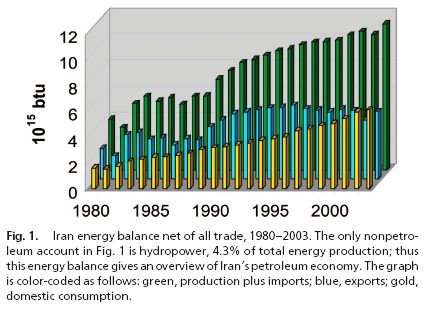
Trendline analysis is a very useful tool, so long as you don't fetishize on a single trend.  The global warming crowd seem to fetishize on carbon dioxide concentrations in the atmosphere, ignoring the overall point that the planet is in one of the lowest points for that in its entire history.  And when pointing at a miniscule century of temperatures, they ignore the 800 million year climate record found by geologists over decades.  Concentrating on the wrong scope, wrong numbers, wrong time-frame and, finally, ignoring that the data, itself, is being undercut by processing errors and instrumentation errors doesn't help.  When you want to analyze trendlines, like say Iran's oil production and its capacity to export, you not only have to ask yourself 'what do the trends signify?' but then ask yourself 'what are the things pushing these trends?'.  From Roger Stern's article released online at 26 DEC 2006 on The Iranian petroleum crisis:

You don't get the capability to leave things out, but as the idea of how to get oil out of the ground, transport it, refine it, sell it, and then look at marginal expansion are *all* far more than a century old (and since the oil industry is an offshoot of mining, that puts those concepts back thousands of years to the first human mining experiences) you do not get to wave your hands around claiming much and citing little.  A process of under-investment, over-utilization and subsidies on refined products all leads in one direction for energy use and the ability to export: the variables are known, the trendlines obvious and the ability to counter them requires years if not more than a decade.

When talking about a larger society, however, the trendlines are not in any one place: society covers a wide gamut of human interactions and trying to see if a suite of them has any sort of defining impact is difficult.  So, when looking at the trends of the US starting in the Vietnam era and onwards, I take a broader sweep of things, due to the inability to actually *measure* these trends in any objective way.  There is no thermometer reading for foreign policy or nationalism amongst a population, no wind-force scale for popular opinion to compare across eras, and no Richter scale to measure the impact of events on a society as a whole.  If there *were* I would use *them*.  So the empirical and 'high water mark' sort of evidence is necessary:

The death toll that accrued to America's unwillingness to stand for her values, stick by an Ally and retreat with mere scratches when entire societies were threatened was enormous. The media conveniently under-reported such things and so retreat was seen as a 'low cost option' against military aggression in far off lands. Mind you, the mightiest economy of the planet was expending less than 10% of its economy and more on the order of 8% to deal with this, continue a build up of thermonuclear weapons, heavily increase its industrial capacity, raise its standard of living by leaps and bounds, put a new era of agriculture in place that would further reduce the manpower needed to feed the Nation, and put forth new science and technology at a phenomenal rate. The USSR, meanwhile, was spending 15-25% of its economy on war material, creating substandard housing, inventing very little, and repressing its people continuously through secret police, gulags and imprisonment without fair trial for stating 'political dissent'. The layer of 'Mutual Assured Destruction' was used to cement the 'balance of power' in place and KEEP IT THERE. Those who had put forth that Foreign Policy had so inculcated the power structure of the West to it, that there was no other option ever put forth that got a hearing on trying to do something different. Grand Strategy had, indeed, become based on fantasy and those holding wonderful reports from the CIA in the late 1980's about how the USSR would be around at least until 2010 and most likely 2030-50 should have been seen as *frauds*: they had so weakened the Nation to respond to *any* attack and counter threats to the Friends and Allies of the United States that the US was no longer seen as a reliable power of any sort.

The loss of identity of the American People to its Foreign Policy strategy is not new. It is traced directly back to Korea and Vietnam where the disenchantment of the American People with supporting dictators, appeasing aggressors and, generally, giving up the ideals of Liberty and Freedom to a 'balance of power' that they started to walk out on the system ITSELF. By the late 1970's the mass movement of the American People was no longer along standard political and ideological axes, but was a growing disenchantment with the political system that would *support* the deterioration of National Sovereignty and the Preceptual belief in the Declaration and the limitation of Government seen in the Constitution. The end of the Cold War did not start this trend which was in full swing by that point in time. The American People believed that the Nation should stand up for some things and the political class was telling it that those things were not worth standing up *for* or doing anything to *continue* them. To have a sense of the lost security on the Global Scale one must first *start* with that sense which America has not had since the middle of the Cold War.

After Vietnam, the destruction of Cambodia, Laos, and the reprisals taken against South Vietnam were huge with death tolls as a result of American cowardice rising into the tens of millions. The USSR saw this as a vital way to undermine the West and the very conception of Western Liberty because their sympathizers in the West had shown an ability to redirect outlook away from Preceptual basis to one of 'no blood now for any reason, ever'. This was not helped by the US non-response to the overthrow of Iran by Islamic Fundamentalists, the botched hostage rescue attempt, the Embassy bombing in Beirut, the Marine Barracks bombing in Beirut, the Second Embassy bombing in Beirut, the Pan Am Lockerbie bombing, the Berlin Disco bombing... The continuous hit parade against the US and its Allies by foes both Communist backed, like the various 'Red' factions/legions and the Pan-Arab to Islamist groups led to further deterioration in the concept that the US would actually address anything outside of herself. The retaking of Kuwait was seen as a validation *of* that because the US would no longer dare to act *alone* in her own interests. And promises given to people wanting to over throw a dictator were not fulfilled and so 300,000 Shia Arabs died due to Saddam Hussein because they actually had this strange belief that the US would actually stand FOR anything it said.

Those are the trendlines of disenchantment of the American people with its government, political class, foreign policy institutions and, in the end, self-alienation from the concept of a Nation supporting liberty and freedom both at home and abroad.

A fertile place to examine how trends can be seen is via 'alternate history' or 'counter-factual history' which both utilize things that did not happen and then look and see what the ongoing trends across societies and nations were and how they would be effected by them.  This I did in my piece looking at how Azar Gat postulated a slightly different outcome to world affairs if North America was not that rich in resources or in any given subset of them (say fresh water or iron ore or fertile land).  A United States with the natural resources at lesser degrees or far harder to get and support would not have been able to sustain the industrial output necessary to fight two World Wars. 

Going a bit further, as I am an alt-history fan, I postulate an even smaller change to Germany pre-WWI that would have long-term and large scale ramifications globally... actually a trivial change historically speaking.  The overall analysis, however, is that of 'contingent effects' being predominant in history: things that are unrelated to societal trends, say natural resources or transportation lines, can impact a wide swath of peoples and the course of nations.  This goes against Marxist views of 'mass-movement historical trends' because those very same mass movements are based upon contingent effects.  Without the basis to get those masses, the movements either don't show up or they show up in a scattered way and exert little overall force.

With any consequential petroleum resources held by Germany and threat to take more of same, plus a stalemate in the Euoropean theater, President Wilson would be forced to put the economic needs of the US aside and join the Allies or to fully fight *all* of the Allies of Germany. There would even be the case made that supporting Germany so as to *influence* it and its allies was in the US interest for the long-term spread of democracy and liberalization of those regimes. That was a case hard to put forth with Germany relatively isolated, but a Germany with more resources and active in the Middle East then puts Germany combat expertise in support of the Ottoman Empire.

World War I was not foreordained to be the US coming in to save the Alliance bacon and then fouling up its handling of the Middle East for 90 years thereafter. With one relatively simple shift in outlook, one that the Kaiser could easily have taken umbrage to, the entire geo-strategic basis for World War I would have changed and harshly. If the Aussies had problems at Gallipoli with Ottoman Turks there, imagine the problems they would have with Germany supported Ottoman troops with more modern weapons and tactics. And securing victory against the Ottomans by the British from the south would have to be concentrated on attempting to regain natural resources and be faced with German troops attempting to isolate Persia and threaten Arabian oil supplies and other Middle Eastern natural resources. Not to speak of the Suez Canal.

One minor rail line that was discontinued but near completion just before the war, could have changed the entire history of WWI with the pre-war plans adjusted to that economic parameter: Germany was very capable of doing that.  The trends of war, in that case, would not be 'mass movement' affairs predicted by socialists, but highly variable affairs based on tiny accidents of history.  Some broader sweeps do happen, say the shift to agricultural societies, but the final forms of those societies winding up into anything like our modern world are not pre-ordained.  If the volcanic island of Thera had not exploded for an additional century, the movement of that early civilization based on Crete and Thera would have been able to thwart Mycenaean attempts to overcome them.  Without that you get no Trojan War.  Indeed, a more highly coherent multi-island society becomes a palpable force with time to spread and the entire history we know after the dawn of the Bronze Age would not have happened as it would shift Egypt and Babylon, too, via trade and intellectual discourse.  Given a century, that early civilization with hot and cold running water to individual homes, indoor siphon based plumbing and other things that would have to wait until Roman times, would have spread faster.  Greater public health via good sanitation saves countless lives daily, and is a simple thing to do.  With agriculture, sanitation and time to build up trade, our world would not be here as we know it... probably we all would be speaking some form of Greek.

That is a contingent effect having a mass movement outcome: it is a necessary mental tool for trendline analysis to be able to postulate a minor change (a change in outcome that is randomly distributed) so that a wider spectrum of subsidiary changes can be examined using our knowledge of how such changes have impacted other societies.  With that being said, when large scale trends do start moving societies, then they continue moving until something else acts upon them.  That is part of the supersaturation concept.  And my best trendlines are actually measurements, although they are direct, like the declining export capability of Iran, they are a bit darker because of what they are showing:

The above taken from US Census datasets.

Voting requires that one be over 18, a citizen of the US and not otherwise stopped from voting via previous convictions for crimes.  We have concepts, in a representative democracy, that include words with attendant ideas:

Majority - the majority of the voting population.

Plurality - a large segment of the voting population that is sub-majority, but not minority.

Minority - generally sub-plurality, to the point where it is non-competitive with a plurality, generally placed under 40% and usually under 30%.

For representative democracy, starting in 1964 for Presidential cycles, the Majority came out to vote in numbers that would allow the winners to claim Plurality status.  In the years between 1976 and 1992 the ability to claim a Majority voting is still in effect, but the resultant government could no longer claim Plurality status and can be considered a Minority with Majority voting.  These are given considering non-'landslide' elections where contests are in the 52% winner and 48% loser arena.  Most elections have been closer to 50/50 with the Nixon and Reagan 'landslides' the exceptions.  The historical trendline for Presidential election years has been downwards with a spike in 1992 and an upward trend between 1996 to 2004, but with 2004 being a high water mark for absolute turnout though a relatively low turn-out considering the 1964 high in that area. We have not had anyone who can even claim to be a Plurality President since 1972 with the sole exception of President Clinton barely clearing that in 1992 and then falling into Minority status in the next election cycle.

If all underlying societal circumstances remain the same over this period for commitment to representative democracy, then the overall trend can be said to indicate a drifting from utilization of the franchise right by a minority, at first, and then by a Plurality.  With the exception of 1992, the Plurality of Americans who can vote have voted with their feet and non-exercise of their franchise as a demonstration of their commitment to representative democracy.  Or in this case non-commitment to that concept.  That underlying trend, if it has no mitigating factors would then trend for the next Presidential election cycle to 'regress towards the mean' or average indicated by the ongoing trend downwards.  I examine that concept of how a mean or average trend via a slope in a graph depicting such things as batting averages, average temperatures and other things has a powerful mathematical backing to it.

Here the interim Congressional election cycles demonstrate the operative slope clearly, with the 1966 high water mark for Congressional turnouts being in 1966 with a slight fall-off in 1970, allowing Congress to claim Majority turnout but to be Minority in representation with close elections as an operative concept.  Starting in 1974 and with every subsequent interim election, there has been a Plurality turnout with Congress moving into pure Minority status for representation.  Dropping below 45% in 1998 and subsequently has cemented that Minority representation and would indicate a decided lack of support from the American voting population.  A slope on the Congressional graph, only done by eye and pure estimation, sees a 12% drop over 9 interim elections after the start of the graph or a general 1.3% drop per interim election cycle election cycle on the Congressional side.  A similar slope dropping approximately 20%, again done by eye, over 10 Presidential election cycles after the start of the graph yields a general 2% voter turnout decline per cycle.  Not having the 2006 turnout information handy for Congress I can't say if that holds up, but as there was no indication of a massive spike in voting that would draw inordinate media attention, the norm may have held.  For the next Presidential cycle that slope would indicate a 54%-56% turnout to return the turnout rate to its declining slope to its mean.

That latter is worrying as, to truly get back in synch with the slope, the amount of area covered by the variation would have to be made up by actually going under 54%.  If the mean has a draw to it then that would seem to be indicated, giving the highly spikey turnout changes in Presidential election years.  For that to happen, both parties would need to nominate individuals that would depress their own voter turnout and the turnout of 'independents'.  A 2% total percentage drop-off would be a minimum expected with a mean drawing the percentage back to historical turnout declines, while a 4% would be the average drop off (thus to just over 54%) and 6% would start to bring the overall trend back into line for a slight recover in 2012.  What happens at 6%, however, is that nearing the 50% turnout line starts to dance with the turnout rate changing from Majority to large Plurality.  A drop to between 50% to 52% starts to be a test of the actual adherence of the American voting age population to representative democracy.  For a representative democracy to claim any legitimacy under majoritarian standards, then a Majority must turn out for elections to be considered as 'representative'.  A slight drop to Plurality turnout then calls into question the actual validity of a representative democracy as representing the 'will of the people' when their will has been demonstrated by not voting. 

There is no 'out' in that function: if you believe in the concept of representative democracy, then there is no plea to 'only the interested vote' or the 'smarter people voting represent those who don't'.  That is patently not the case as the former is actually citing that representative democracy is not working and the latter is suggesting some form of authoritarian outlook by a Minority to rule the Majority.  The glib answers like that must end when representative democracy founders with such low turnouts.  If there is no interest in common government, then government is no longer able to serve the common man and must guess at what that common man wants.  And do notice that every social program, every educational program, every pork barrel project, every enticement, every bribe, every payoff to the people with their own money has not brought out more people to actually *support it*.

The longer term artifacts of this have been showing up in other, derivative data sets based on Congressional votes.  Looking at that in Running the numbers: Polarized America, I found the following:

What is more troubling than that, and being witnessed this election season, is the two parties fielding presumptive candidates that are, inherently, starting to cause party faithful to waiver. If candidates in both parties cause a minor drop in their own base participation, say 10%, then the percentage voting drops very close to 50%, just nudging over it by a bit. At 15% it drops just below 50% turnout. At that point representative democracy goes from plurality government to true minority government, representing a sub-part of plurality. Even with minority government status being reached de facto for many years, the absolute shift where true plurality of the voting age assent is given is no longer in hand.

Gridlock is actually not a problem but the solution being given by the political center in the US: it is the only ready means at hand to keep the two parties in mutual check so that they can not run an activist government. The ability to actually be wealthy and not have that pathway to wealth put in danger is a sub-marking point of the larger demographic shift by the center. As government is a user of wealth, not a creator of it, the political center is now saying to both parties that what they created during the Depression to mid-1970's is not what is wanted by them, and they are willing to let the two parties drift hard apart from each other by not participating in representative democracy. We hear much from the two party activists, but the quiet and dead silence from the middle is attempting to marginalize both parties into ineffectual stalemate.

For all the activism being seen, those very same activists ignore the fact that more and more people are no longer voting.  If said activist views towards government 'helping people' were correct, turnout would have been on the rise for the last four decades, and yet just the opposite has happened.  That growing Plurality is using its right NOT to vote as a negating power by pitting activists against each other into 'gridlock'.  If that Plurality had wanted *either side* to dominate, it would dominate, and yet we have 'gridlock'.  That 'gridlock' indicates a bankrupt outlook by the two parties that has gotten worse and continues to do so, on average, for every election since 1964.  There is also no support for 'bipartisanship' as the polarizing process has driven that out of the political arena: it has not served a purpose to this growing plurality and so it is nearly gone from politics.  Bipartisanship has not yielded something useful to the non-voting Plurality and so they continue to grow in numbers as more and more are turned off by 'bipartisanship' and party 'activism' for 'causes'.

As I said way back when: things in Iraq have good trendlines and have seen those increasing since 2006, while things in the US have been going downwards for decades heading into troubled waters.  You start to see this effect now being cited by a few others, like Ralph Peters in an article at the NY SUN on 28 JUN 2008, looking at the lies told by the political elite and the media about Iraq, terrorism and the condition of things in the US and globally:

Every single significant indicator, from Iraqi government progress through the performance of Iraqi security forces to the plummeting level of violence, has changed for the better - remarkably so.

If current trend-lines continue, it may not be long before Baghdad is safer for Iraqi citizens than the Washington-Baltimore metroplex is for US citizens. Iraq's government is working, its economy is booming - and its military has driven the concentrations of terrorists and militia from every one of Iraq's major cities.

While the US is trying to ignore a growing insurgency problem south of the US border.

Not that either of the two parties will address that, nor the spillovers that are now happening in the US because of it.  The first teams of hitmen roaming the Southwestern US have already started to arrive.  But 'activist' candidates won't address that.

Which is a symptom of failing democracy in the United States.